AI Product Photography at Scale: Guardrails Over Generation
AI Product Photography at Scale: Guardrails Over Generation
Keywords: ai product photography ecommerce, ai fashion photography, virtual model photography, ai image generation at scale
Introduction
A luxury fashion retailer asked us to generate on-model product photography for hundreds of SKUs. No photoshoot. No models. No studio. Take a flat-lay or mannequin image of a garment and produce a realistic image of a person wearing the item in a contextual setting.
The first challenge: luxury brands have standards. You can't put a designer jacket on a generic AI person in a generic AI room. The model, pose, lighting, and setting all need to feel premium.
The second challenge: consistency. Hundreds of items browsed together need to feel cohesive. Not "hundreds of different AI generations."
The third challenge: accuracy. The garment needs to look exactly like the real product. If the AI hallucinates an extra pocket or changes the colour, that's a customer return waiting to happen.
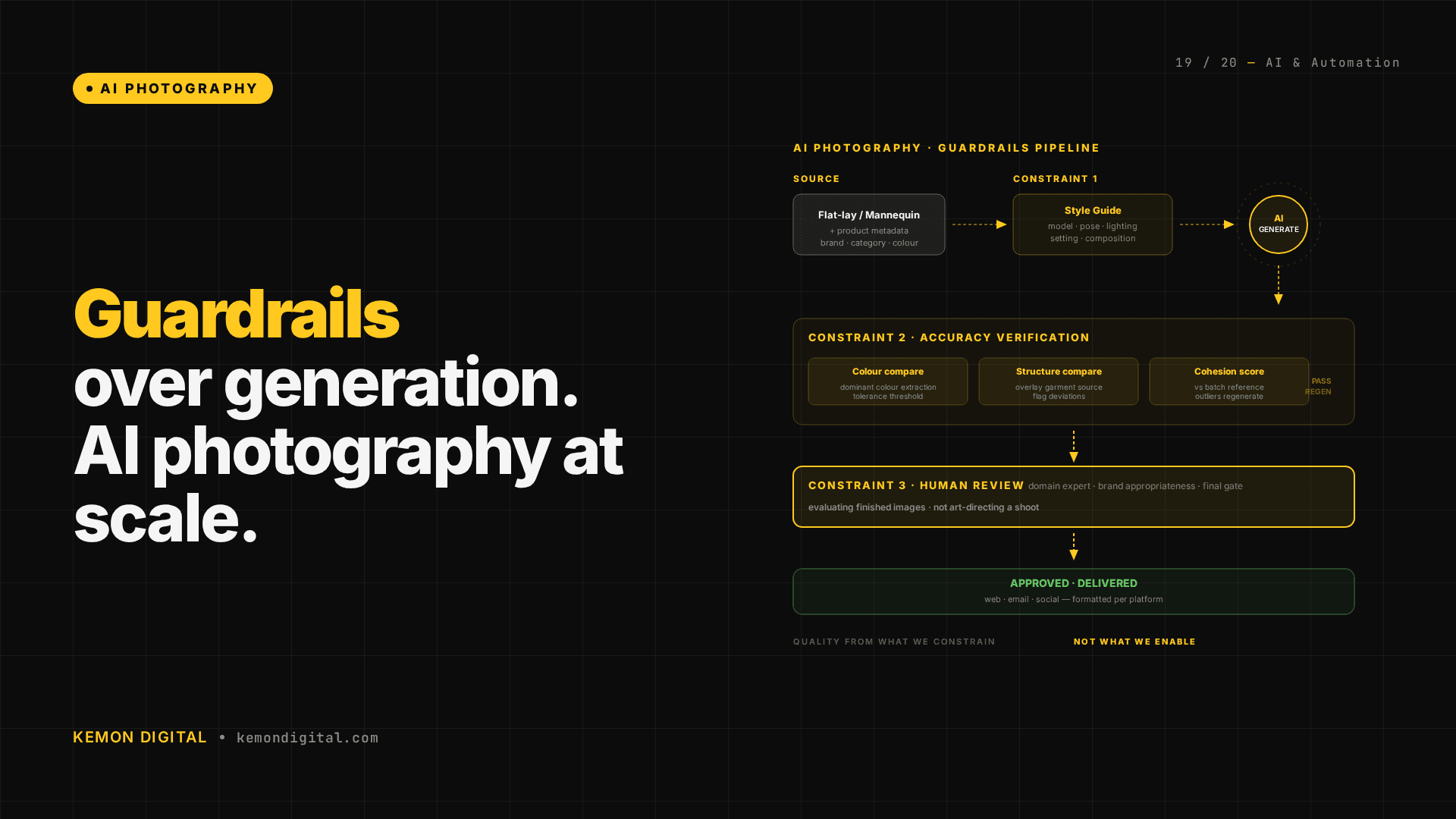
We solved all three with the same principle: guardrails over generation. The quality comes from what we constrain, not what we enable.
Why Traditional Photography Doesn't Scale
Traditional product photography works beautifully for dozens of items. Book a studio, hire models, shoot for a few days, edit, deliver. The output is high-quality and brand-appropriate.
It falls apart at scale. A luxury retailer carrying hundreds of brands with tens of thousands of SKUs can't shoot every product on a model. The economics don't work — the cost per image, the coordination across brands, the turnaround time. Products arrive and need to be online within days, not weeks.
The result is that most large catalogues rely on flat-lay photography or mannequin shots for the majority of their inventory. On-model imagery is reserved for hero products and campaign pieces. The rest of the catalogue gets functional-but-uninspiring photography that doesn't drive conversion the way on-model imagery does.
AI product photography changes the economics. The cost per image drops by an order of magnitude. The turnaround is hours, not weeks. And the quality — when constrained properly — is commercially viable.
The Three Constraints
Constraint 1: Style Guide as Prompt Architecture
Every luxury brand has a visual identity. The AI needs to understand and reproduce it.
We build a style guide into the generation pipeline for each brand tier:
- Model characteristics — age range, build, pose style, expression. Not left to chance. Not randomised. Defined per brand positioning.
- Setting and lighting — studio vs. lifestyle. If studio: backdrop colour, lighting direction, shadow style. If lifestyle: setting type, colour temperature, depth of field.
- Composition — framing rules, garment visibility requirements, negative space. The garment is the hero, not the model or the setting.
These constraints are encoded in the prompt architecture, not applied after the fact. The AI generates within the style guide from the first pixel.
Constraint 2: Garment Accuracy Verification
This is the non-negotiable. The AI-generated image must match the real garment.
Common failure modes:
- Colour drift — the AI shifts the colour slightly. A navy becomes royal blue. A cream becomes white. Subtle but commercially unacceptable.
- Detail hallucination — the AI adds elements that don't exist. An extra button. A pocket that isn't there. A pattern that's slightly different.
- Proportion distortion — sleeves that are too long, collars that are too wide, fits that don't match the actual sizing.
We address each with automated verification:
- Colour comparison — extract dominant colours from source and generated image, compare within a tolerance threshold.
- Structural comparison — overlay the garment from the generated image against the source and flag deviations above threshold.
- Human QA — a final pass where a human compares the generated image to the source product. This catches what automation misses.
Constraint 3: Batch Consistency
Individual images might look great. Browse fifty of them together and the inconsistencies become obvious — different lighting temperatures, different model proportions, different background tones.
We enforce consistency through:
- Locked style parameters — once the style guide is set for a batch, parameters don't drift between generations.
- Reference image anchoring — each batch has reference images that define the target look. Every generation is evaluated against the reference, not just against the prompt.
- Cohesion scoring — a separate evaluation pass that scores each image against the batch mean on colour temperature, brightness, and composition. Outliers are regenerated.
The Pipeline
The full generation pipeline:
- Source image ingestion — flat-lay or mannequin photograph of the garment, plus product metadata (brand, category, material, colour).
- Style guide lookup — the system matches the brand/category to the appropriate style guide. Premium brands get a different treatment than contemporary lines.
- Generation — the AI produces the on-model image within the style guide constraints.
- Automated QA — colour comparison, structural comparison, cohesion scoring. Pass or regenerate.
- Human review — domain expert compares against source, evaluates brand appropriateness, flags any issues.
- Delivery — approved images are formatted for the target platform (web, email, social) and delivered.
Steps 3-4 can repeat. If the first generation fails QA, the system regenerates with adjusted parameters. Most garments pass within one to two attempts. Complex items (heavily patterned, unusual silhouettes) may take more.
The Guardrails-Over-Generation Principle
This is the core lesson, and it applies far beyond product photography.
Anthropic's guidance on building production AI systems emphasises constraining the output space rather than expanding the model's creative freedom. When you're running AI at scale, quality comes from what you prevent, not what you permit.
Applied to product photography:
- Don't: ask the AI to generate creative, beautiful fashion photography.
- Do: define exactly what the output must look like (style guide), what it must not do (no garment modifications), and where humans verify (final QA).
The same principle applies to any AI system operating at commercial scale:
- Content generation — define the schema, not the voice. Constrain the output format, required elements, and forbidden phrases. Let the AI operate freely within those boundaries.
- Data analysis — define the analytical framework, not the conclusions. Specify what questions to ask, what format to present findings in, and what counts as actionable. The AI fills in the analysis within those constraints.
- Customer communications — define the tone, legal requirements, and escalation triggers. The AI drafts within those guardrails. Anything outside gets flagged for human review.
In every case, the quality comes from the guardrails, not the model.
Economics
The cost comparison for a catalogue at scale:
Traditional photography: hundreds of dollars per look (model fee, studio time, editing, coordination). At hundreds of SKUs, the cost is prohibitive for all but hero products.
AI photography with guardrails: a fraction of that per image (generation cost + automated QA + human review). The human review is the largest cost component, but it's evaluating finished images — not art-directing a shoot.
The break-even point is typically in the low tens of images. Above that, AI photography is materially cheaper. Below that, traditional photography may still be preferable for the quality ceiling it offers on hero products.
Most retailers will run both: traditional photography for campaign and hero products, AI photography for the long tail of the catalogue. The two aren't competing — they serve different tiers of the product hierarchy.
FAQ
Q: Can the AI match the exact fabric texture?
A: Current models handle smooth fabrics, knits, and solid colours well. Complex textures (tweed, bouclé, heavy embroidery) are more challenging and require more regeneration attempts. Fabric accuracy is the area with the most improvement happening quarter-over-quarter.
Q: What about size-inclusive and diverse model representation?
A: The style guide defines model characteristics per brand. Diversity and size inclusivity are part of that specification. The AI can generate across a range of body types, skin tones, and ages. The key is that this is defined intentionally in the style guide, not left to the model's defaults.
Q: How do customers react to AI-generated photography?
A: When the guardrails are working, customers don't notice. The images look like standard e-commerce photography. The failure mode is when guardrails are insufficient — colour drift, detail hallucination, or uncanny-valley model rendering. That's why the QA pipeline matters more than the generation model.
Q: Does this replace the need for a creative director?
A: No. It shifts the creative director's role from overseeing individual photoshoots to defining the style guides and QA standards that govern the AI pipeline. The creative vision is still human. The execution at scale is AI-assisted.
Q: What model/tool do you use for generation?
A: The specific model matters less than the pipeline around it. Image generation models improve rapidly — what's state-of-the-art today will be surpassed within months. The style guides, QA checks, and consistency scoring are the durable assets. Those transfer across models.