Our AI Caught Its Own Data Bug — Why Feedback Loops Matter More Than Model Quality
Our AI Caught Its Own Data Bug — Why Feedback Loops Matter More Than Model Quality
Keywords: ai self correction feedback loops, self-improving ai agents, production ai systems, ai data quality
Introduction
During the first full-cycle run of our analytics system on a luxury fashion retailer, the system caught a data processing issue that was affecting approximately half of all transaction line items. It identified the anomaly, traced the root cause, corrected its own processing logic, and updated its instruction set to prevent recurrence — all within the same analysis cycle, without human intervention.
This wasn't a bug fix. This was a self-improving system doing exactly what it was designed to do. And the story of how it happened illustrates why feedback loops are the most undervalued component in production AI systems.
What Happened
The root cause was a Shopify multi-item order export nuance. When an order contains multiple products, Shopify exports it as multiple rows with the same order ID. Each row represents one line item. If you sum the order totals naively, you double-count (or triple-count, or worse) revenue on every multi-item order.
Our data standardisation agent was doing exactly that. Multi-item orders were inflating the revenue figures.
Here's the sequence that followed:
-
Anomaly detection. The orders agent flagged that its calculated revenue didn't reconcile with known totals from other data sources. The numbers were too high, and the discrepancy was consistent — not random.
-
Root cause tracing. The system examined the CSV export structure and identified that multi-item orders were represented as duplicate rows. It traced the inflation to the summing logic in the standardisation step.
-
Self-correction. The data standardisation agent updated its processing logic to deduplicate by order ID before summing — counting each order's total once, regardless of how many line items it contained.
-
Instruction update. The instruction-refinement agent added a permanent rule to the standardisation framework: always deduplicate Shopify exports by order ID before aggregating revenue. This persists across future cycles.
The entire sequence — detect, diagnose, fix, persist — completed within the same analysis cycle. No human flagged the issue. No human wrote the fix.
Why This Matters More Than Model Quality
The AI industry is obsessed with model quality. Bigger context windows. Better reasoning. Higher benchmark scores. All of that matters. But in production systems, the quality of the feedback loop matters more.
Here's why:
Model quality determines the ceiling. A more capable model can analyse more complex data, reason across more dimensions, and produce more nuanced findings. But model quality is a static property — it doesn't improve between cycles unless you upgrade the model.
Feedback loop quality determines the trajectory. A system with effective feedback loops gets better every cycle. It catches its own errors, incorporates human corrections, and refines its analytical frameworks over time. A mediocre model with excellent feedback loops will outperform a superior model with no feedback mechanism within a few cycles.
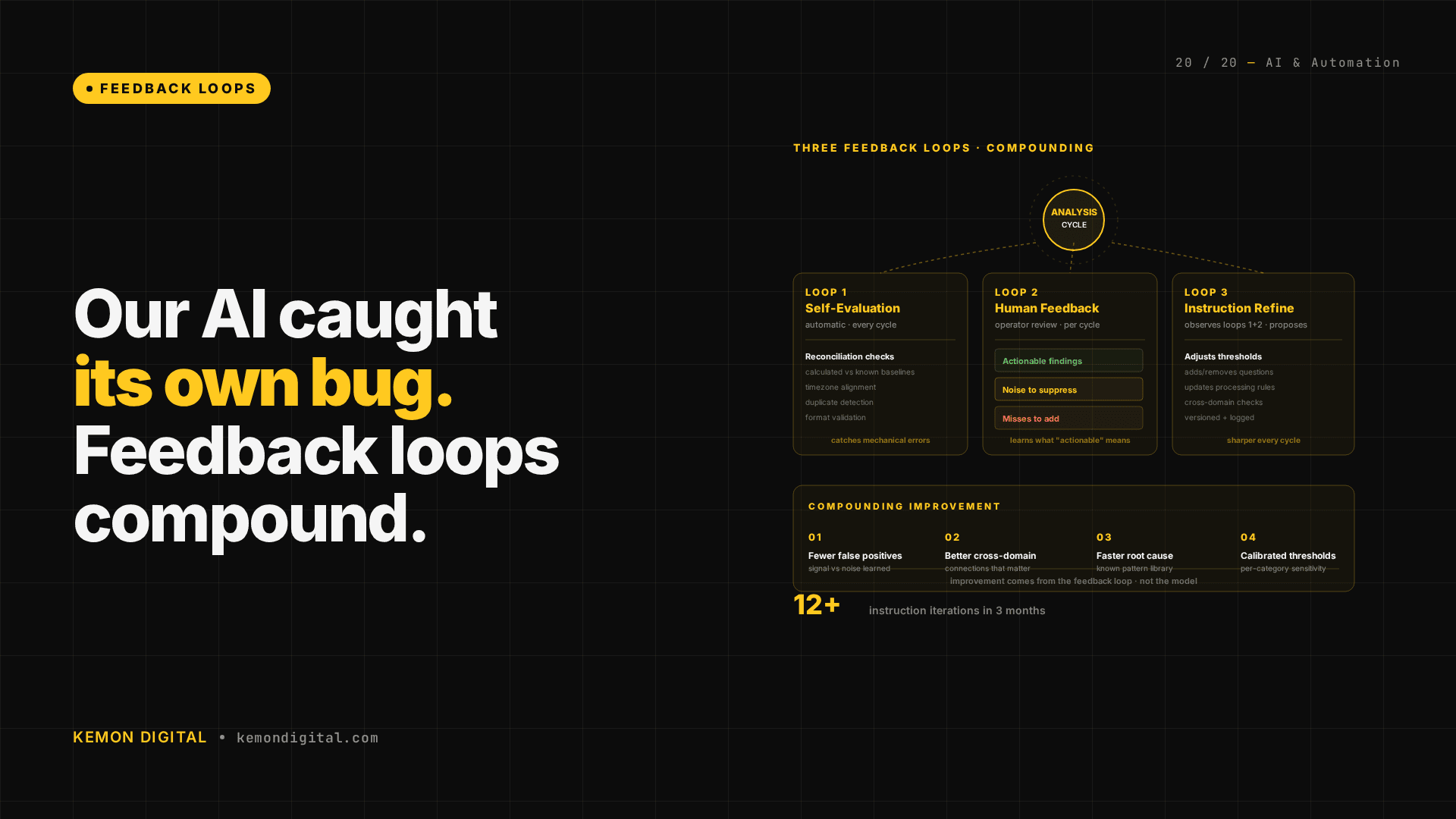
Our system has been through over a dozen instruction iterations in its first three months. Each iteration makes it sharper — fewer false positives, more actionable findings, better cross-domain connections. That compounding improvement is entirely a function of the feedback loop, not the model.
The Three Feedback Loops
We built three dedicated feedback mechanisms into the system:
Loop 1: Self-Evaluation
Every analysis cycle includes reconciliation checks. The system compares its calculations against known baselines — total revenue from the order management system, total ad spend from the platform dashboards, total email sends from the ESP. When its numbers don't match, it flags the discrepancy and investigates.
This is the loop that caught the Shopify export issue. It's also caught timezone misalignment between data sources, currency conversion errors in multi-market data, and duplicate records from overlapping export windows.
Self-evaluation is the cheapest feedback loop. It runs automatically, catches mechanical errors, and requires no human input. But it can only catch errors where a known baseline exists.
Loop 2: Human Feedback
After each analysis cycle, findings are reviewed by the operator. The review captures three things:
- Actionable findings — insights that led to a concrete decision or action. These are positive signal that the analytical framework is working.
- Noise — findings that are technically correct but not useful. These indicate the framework is asking the wrong questions or setting thresholds too sensitively.
- Misses — things the operator expected to see but the system didn't surface. These are gaps in the analytical framework.
The feedback-processing agent ingests this review and updates the pattern library. Over time, the system learns what "actionable" looks like for this specific business — which is different for every client.
Loop 3: Instruction Refinement
The instruction-refinement agent observes the outputs of Loops 1 and 2 and proposes changes to the analytical frameworks that each channel agent runs.
Changes might include:
- Adjusting thresholds for what counts as an anomaly
- Adding new questions to a channel agent's framework
- Removing questions that consistently produce noise
- Updating data processing rules (like the Shopify deduplication fix)
- Adding cross-domain checks that the synthesis agent should look for
Each proposed change is logged and versioned. We've run automated audits after every instruction change — scanning all instruction pages and catching several issues per scan. The instruction set is a living document that evolves with every cycle.
What Most AI Systems Get Wrong
Most production AI systems are built as "run and report" — send data in, get analysis out, repeat. There's no mechanism for the system to improve itself between runs. Every cycle is exactly as good (or bad) as the first one.
The common failures:
No reconciliation. The system produces numbers and nobody checks whether they make sense. The Shopify double-counting bug would have persisted indefinitely in a system without self-evaluation.
No feedback capture. Operators review the output, make decisions, but their reasoning is never fed back into the system. The system keeps making the same mistakes and surfacing the same noise because it has no mechanism to learn from human judgment.
No instruction versioning. Even when improvements are made, they're ad-hoc prompt tweaks that aren't tracked, tested, or systematic. The next time the system is set up for a new client, the learnings from the previous one don't transfer.
Building the feedback loops takes maybe 20% of the total system design effort. The compounding returns over months of operation make it the highest-ROI investment in the entire architecture.
The Compounding Effect
After a dozen iterations, the difference is measurable:
Fewer false positives. Early cycles surfaced findings that were technically correct but not actionable — a revenue dip that was just a public holiday, a CPA increase that was a seasonal pattern. The feedback loop learned to distinguish signal from noise for this specific business.
More actionable cross-domain findings. Early synthesis was broad. After feedback identified which cross-domain connections actually led to decisions, the synthesis agent focused on those patterns and deprioritised the rest.
Faster root cause identification. The self-evaluation loop has built a library of known error patterns (timezone mismatches, export format changes, duplicate records). New anomalies are checked against this library first, resolving common issues in seconds.
Better threshold calibration. What counts as "significant" depends on the business. A 5% revenue dip might be noise for one category and a crisis for another. The feedback loop calibrates these thresholds based on historical action rates — if operators consistently act on 5%+ dips in Category A but ignore them in Category B, the thresholds adjust.
None of this improvement comes from a better model. It comes from a system that learns from its own operation.
Building Your Own Feedback Loops
You don't need a multi-agent system to implement feedback loops. The principle applies to any AI workflow:
Self-evaluation: after any AI-generated analysis, cross-check the outputs against known baselines. Revenue calculations should match your order system. Email metrics should match your ESP dashboard. If they don't, investigate before trusting the analysis.
Human feedback capture: after reviewing AI outputs, spend two minutes noting what was useful, what was noise, and what was missing. Store those notes. Review them monthly. The patterns tell you how to improve the prompts or frameworks.
Instruction versioning: when you improve an AI prompt or workflow, write down what changed and why. Keep a changelog. When the same issue recurs, check whether the fix was actually applied. When setting up a new workflow, review the changelog from similar past projects.
The feedback loops are simple. The discipline to maintain them is what most teams lack.
FAQ
Q: Doesn't self-correction risk the AI making things worse?
A: The self-correction in our system is scoped to data processing rules — deduplication, timezone handling, format normalisation. It doesn't self-modify its analytical judgments. Those are refined through human feedback, not automated self-correction. The distinction matters: mechanical fixes are safe to automate; analytical judgment requires human oversight.
Q: How many cycles before the feedback loop shows measurable improvement?
A: We typically see meaningful improvement after three to four cycles with active human feedback. Self-evaluation catches mechanical issues from cycle one. Instruction refinement compounds over time — the first few iterations make the biggest difference, then improvements become more incremental.
Q: Does this work with off-the-shelf AI tools?
A: Partially. You can implement self-evaluation (reconciliation checks) and human feedback capture with any tool. Instruction refinement requires a system where you control the prompts or frameworks — which is possible with API-based tools but not with consumer chat interfaces.
Q: How much human time does the feedback loop require?
A: The human feedback step takes fifteen to thirty minutes per cycle — reviewing findings, noting what was useful, flagging what was missed. That's the only human input required. Self-evaluation and instruction refinement run automatically.
Q: What's the risk of feedback loops creating echo chambers?
A: Real risk. If the only feedback is "what the operator acted on," the system optimises for the operator's blind spots too. We mitigate this by periodically having a different reviewer do the feedback pass, and by maintaining a set of baseline checks that the feedback loop can't override.