Your Analytics Dashboard Is Lying to You — Here's How Cross-Platform Diagnosis Works
Your Analytics Dashboard Is Lying to You — Here's How Cross-Platform Diagnosis Works
Keywords: cross platform ecommerce analytics, multi-channel analytics, ecommerce data diagnosis, cross-domain insights
Introduction
GA4 says traffic is up 20%. Shopify says revenue is flat. Your email platform says open rates are at 45%. Actual email click-through rate is 1.2%.
Each tool tells its own story. Nobody's connecting the chapters.
This is the fundamental problem with e-commerce analytics as it's practiced today. Every platform provides reporting on its own domain. GA4 reports traffic. Shopify reports orders. Mailchimp reports email metrics. Google Ads reports campaign performance. Each one is accurate within its scope. None of them cross-reference with each other to explain why something is happening.
We designed our analytics system to solve this — not by building another dashboard, but by building a system that reasons across data sources simultaneously. This article explains the difference between reporting and diagnosis, why the parallelisation pattern is the key to making it work, and what cross-platform insights actually look like in practice.
Reporting vs Diagnosis
Reporting tells you what happened. Traffic was up 20%. Revenue was flat. Email open rates were 45%.
Diagnosis tells you why, by connecting signals across domains.
Traffic is up 20% — but it's all from a single campaign that's driving low-intent visitors who bounce. Revenue is flat because the traffic increase didn't bring buyers. Email open rates are 45% — but that's inflated by bot activity; the real engagement metric (click-through) is 1.2%, which means the emails aren't driving action.
That chain of reasoning requires holding traffic data, order data, email data, and campaign data in view simultaneously. No single analytics tool provides that view because each tool only sees its own domain.
The gap between reporting and diagnosis is exactly the gap between "what happened" and "what should we do about it." Reporting generates questions. Diagnosis generates actions.
Why Parallelisation Matters
The naive approach to cross-platform analysis is sequential: analyse orders, then products, then email, then website, then market data. Run five analyses one after another.
This fails for two reasons:
1. Context loss. By the time you've finished the fifth analysis, you've lost the granularity of the first. The insights from the orders analysis that would have connected to the email findings are no longer in working memory — either yours or the AI's.
2. No cross-referencing framework. Sequential analysis produces five separate reports. Nobody's designed the step that connects them. The cross-domain patterns — the ones that matter most — fall through the cracks.
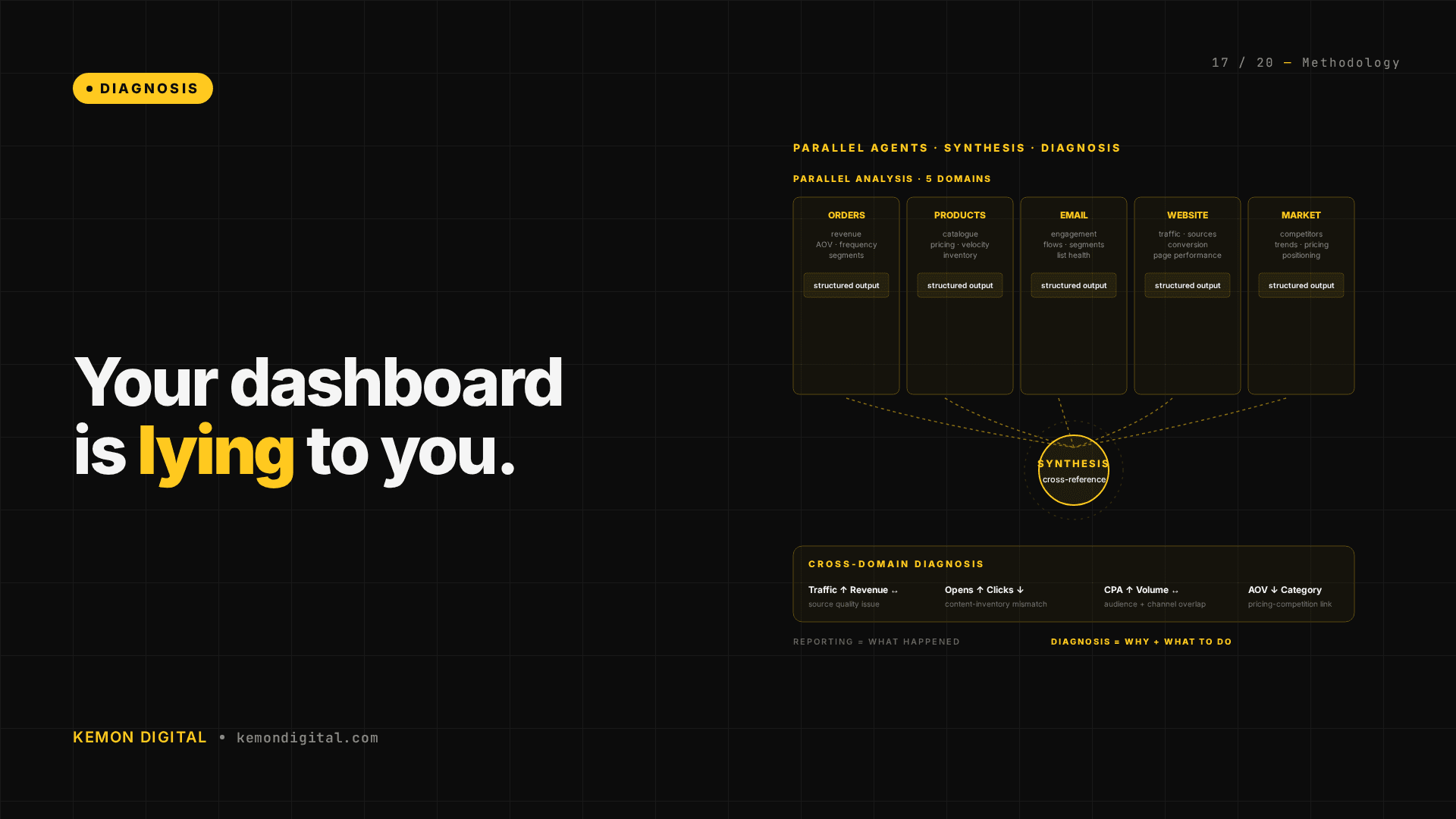
Anthropic's agent design research describes the parallelisation pattern as the alternative: run multiple specialised agents simultaneously on different data sources, then aggregate their findings in a dedicated synthesis step.
Each agent runs in parallel, goes deep in its own domain, and produces structured output. The synthesis agent reads all outputs at once and looks for patterns that only emerge when multiple domains are viewed together.
The parallelisation isn't just about speed (though it is faster). It's about the synthesis step having access to deep analysis from every domain simultaneously — which is what makes cross-platform diagnosis possible.
What Cross-Platform Diagnosis Looks Like
Here are four real patterns that cross-platform diagnosis surfaces and single-platform reporting misses:
Pattern 1: Traffic Up, Revenue Flat
What reporting says: "Great news — traffic increased 20% this month."
What diagnosis says: The traffic increase is entirely from one Google Ads campaign targeting broad-match keywords. Those visitors have a bounce rate over 80% and a conversion rate near zero. Meanwhile, direct traffic — your highest-converting channel — is down 5%. Revenue is flat because you're spending money to replace high-intent visitors with low-intent ones.
Action: Restructure the broad-match campaign. Investigate why direct traffic declined (brand search volume? Repeat customer retention?).
Pattern 2: High Open Rates, Low Revenue from Email
What reporting says: "Email is performing well — 45% open rate."
What diagnosis says: Open rate is inflated by bot activity and Apple Mail Privacy Protection. Real engagement (click-through rate) is 1.2%. The campaigns driving those clicks are promoting a product category where inventory is low — so the visitors who do click through can't buy what they came for. Revenue from email is low not because the emails are bad, but because the inventory-to-promotion alignment is broken.
Action: Cross-reference email campaign content with inventory availability before sending. Redirect promotion to in-stock categories.
Pattern 3: AOV Dropping in a Category
What reporting says: "Average order value in Category X dropped 12% this month."
What diagnosis says: The products agent identifies that three high-AOV SKUs in Category X were repriced upward last month. The orders agent confirms that units sold for those SKUs dropped significantly. The market agent shows a competitor launched a promotion in the same category. The AOV drop isn't a demand problem — it's a pricing-and-competition problem concentrated in three specific SKUs.
Action: Review pricing on the three SKUs relative to the competitor promotion. Consider a targeted counter-promotion rather than a category-wide discount.
Pattern 4: Campaign Costs Rising, Same Volume
What reporting says: "CPA increased 18% month-over-month."
What diagnosis says: The increase is concentrated in two retargeting campaigns that are running against audiences with stale cookie windows. The website agent confirms that the landing pages for those campaigns haven't been updated in months. The email agent shows that the same audience is receiving both retargeting ads and email campaigns with different offers — creating message confusion. CPA is rising because the retargeting is chasing an audience that's already been contacted through a cheaper channel.
Action: Shorten retargeting windows. Coordinate ad and email messaging. Suppress email-engaged users from retargeting audiences.
The Architecture Behind It
Each pattern above requires data from at least two domains analysed simultaneously. The architecture that enables this:
Five parallel agents — orders, products, email, website, market. Each runs a scoped analytical framework designed for its domain. Each produces a structured findings document.
One synthesis agent — reads all five findings documents in a single context. Applies a cross-referencing framework that looks for connected signals: when two or more agents flag findings in the same timeframe, same category, or same customer segment, the synthesis agent investigates the connection.
Structured output format — each finding includes: domain, signal strength, timeframe, affected segment or category, and links to related findings from other domains. This structure is what makes cross-referencing possible. Without it, the synthesis agent would be reading five free-text reports and guessing at connections.
The design principle: let each agent be an expert in one data domain. Build the synthesis step as a separate, dedicated layer that cross-references structured outputs. That's where the diagnosis lives.
Building Your Own Cross-Platform View
You don't need a multi-agent system to start thinking in cross-platform terms. Here's the manual version:
Step 1: Align timeframes. Pull data from all platforms for the same period. Most cross-platform analysis fails because the GA4 report covers last month, the email report covers the last campaign, and the ad report covers the last seven days.
Step 2: Find the common dimensions. Product category, customer segment, and campaign are the most useful. If your orders data, ad data, and email data can all be filtered by product category, you can cross-reference them.
Step 3: Ask connecting questions. Not "how did email perform?" but "how did email perform for the same product categories where ad CPA is rising?" Not "what's our conversion rate?" but "what's our conversion rate by channel for the customer segments that email is targeting?"
Step 4: Look for contradictions. When two platforms tell different stories about the same dimension, that's where the insight lives. Traffic up but revenue flat. Open rates high but click-through low. Ad spend increasing but conversion rate declining.
The manual version is slower but builds the same analytical muscle. The AI version runs it on a regular cycle so the patterns are caught in days, not quarters.
FAQ
Q: Can I build this with Looker / Tableau / Power BI?
A: BI tools can build cross-platform dashboards if you centralise the data in a warehouse. What they can't do is the reasoning step — the synthesis that says "these three signals from three platforms are connected and here's why." BI gives you the view. Diagnosis gives you the interpretation.
Q: How much data do I need for cross-platform analysis to be useful?
A: Enough to identify patterns — typically 30+ days of data across at least two channels. The cross-referencing becomes more valuable as you add domains. Two domains (e.g., ads + orders) is useful. Four or five domains is where the diagnosis patterns get genuinely hard to replicate manually.
Q: What if my data is in different formats across platforms?
A: That's expected. Every platform exports differently. The data standardisation step — normalising schemas, timestamps, and identifiers — is necessary before any cross-platform analysis. This is a one-time setup per platform, not a per-cycle cost.
Q: How do I prioritise which cross-platform connections to investigate?
A: Start with revenue impact. Which connections, if acted on, would most directly affect revenue or reduce wasted spend? Traffic-to-conversion and spend-to-revenue connections are typically the highest-impact starting points.
Q: Is this the same as a data warehouse approach?
A: A data warehouse centralises the data. Cross-platform diagnosis is the analytical layer that sits on top. You can do diagnosis without a warehouse (using exported CSVs), and you can have a warehouse without doing diagnosis (most companies do). The warehouse makes the data available; the analytical framework makes it useful.