The Revenue Leak Audit: How We Found Over 60% of Ad Spend Going to Zero-Conversion Campaigns
The Revenue Leak Audit: How We Found Over 60% of Ad Spend Going to Zero-Conversion Campaigns
Keywords: ecommerce revenue leak audit, google ads zero conversions, email list audit, ad waste framework
Introduction
We audited a B2B e-commerce platform and found that over 60% of their Google Ads budget was funding campaigns with zero conversions. Not low conversions — zero. At the same time, their email list of tens of thousands of contacts was over 90% unusable: bots, invalid addresses, and unengaged contacts masking a much smaller core of actual buyers.
This isn't unusual. Revenue leaks at this scale are the norm in e-commerce operations that have grown faster than their measurement and targeting infrastructure. The leaks aren't dramatic failures — they're slow drains that accumulate because no single report surfaces them all in one view.
This article walks through the audit framework we use, the specific patterns we found, and the evaluator-optimizer principle that makes this repeatable instead of a one-off heroic effort.
The Two Types of Revenue Leaks
Revenue leaks in e-commerce fall into two categories:
Active leaks — money leaving the building. Ad spend on campaigns that generate clicks but no conversions. Budget allocated to search terms that don't match your product catalogue. Retargeting spend chasing visitors who were never purchase-intent in the first place.
Passive leaks — value sitting untapped. Email lists full of real buyers that nobody is mailing. Customer segments that haven't been targeted. Dormant contacts that could be reactivated with the right sequence. Revenue potential that exists in the data but isn't being captured.
Most audits focus on the active leaks because they show up in spend reports. The passive leaks are often larger but invisible because they don't appear in any dashboard — they're the absence of action on an opportunity.
What We Found: The Ad Spend Leak
The B2B platform was running Dynamic Search Ad (DSA) campaigns alongside manual campaigns. DSA campaigns let Google automatically match your site content to search queries. When they work, they're efficient. When they run unchecked, they're a budget fire.
The pattern:
Google was matching the store to search terms that had nothing to do with what it sold. The DSA campaigns had no negative keyword strategy and minimal exclusions. Budget was leaving the account daily with no return.
When we pulled the search term report and cross-referenced against conversion data, the picture was clear: over 60% of total ad spend was funding campaigns and ad groups with zero purchase conversions. Not "low ROAS" — literally zero attributable revenue.
What we did:
We paused the zero-conversion ad groups — over a dozen of them. Then we restructured the remaining campaigns into targeted ad groups organised by product category, each with a negative keyword list built from the search term report. Total ad groups went from scattered and unchecked to fewer than ten tightly-scoped groups.
The result: the same monthly budget, now concentrated on campaigns that were actually generating conversions.
What We Found: The Email Leak
The platform had a contact list of tens of thousands of addresses. On paper, that's a significant asset. In practice, it was almost entirely unusable.
The pattern:
Over 10% of the list was spam bots — automated signups that inflated historical metrics. Open rates looked impressive on dashboards, but those opens were bots, not buyers. The vast majority of remaining contacts were either invalid addresses or completely unengaged.
Buried underneath the noise: roughly 10% of the list was viable — real humans who had actually purchased something. That's the addressable audience. The other 90% was masking it.
What we did:
Domain authentication came first — DKIM, SPF, and DMARC needed to be configured before any campaign could safely send without landing in spam. Then list cleaning: bots purged, invalid addresses removed, and the viable contacts segmented by purchase history and engagement signals.
The recovered audience was roughly 10x the active subscriber count the platform had before the audit. Those contacts existed in the database the entire time — they just hadn't been identified, cleaned, or targeted.
The Evaluator-Optimizer Pattern
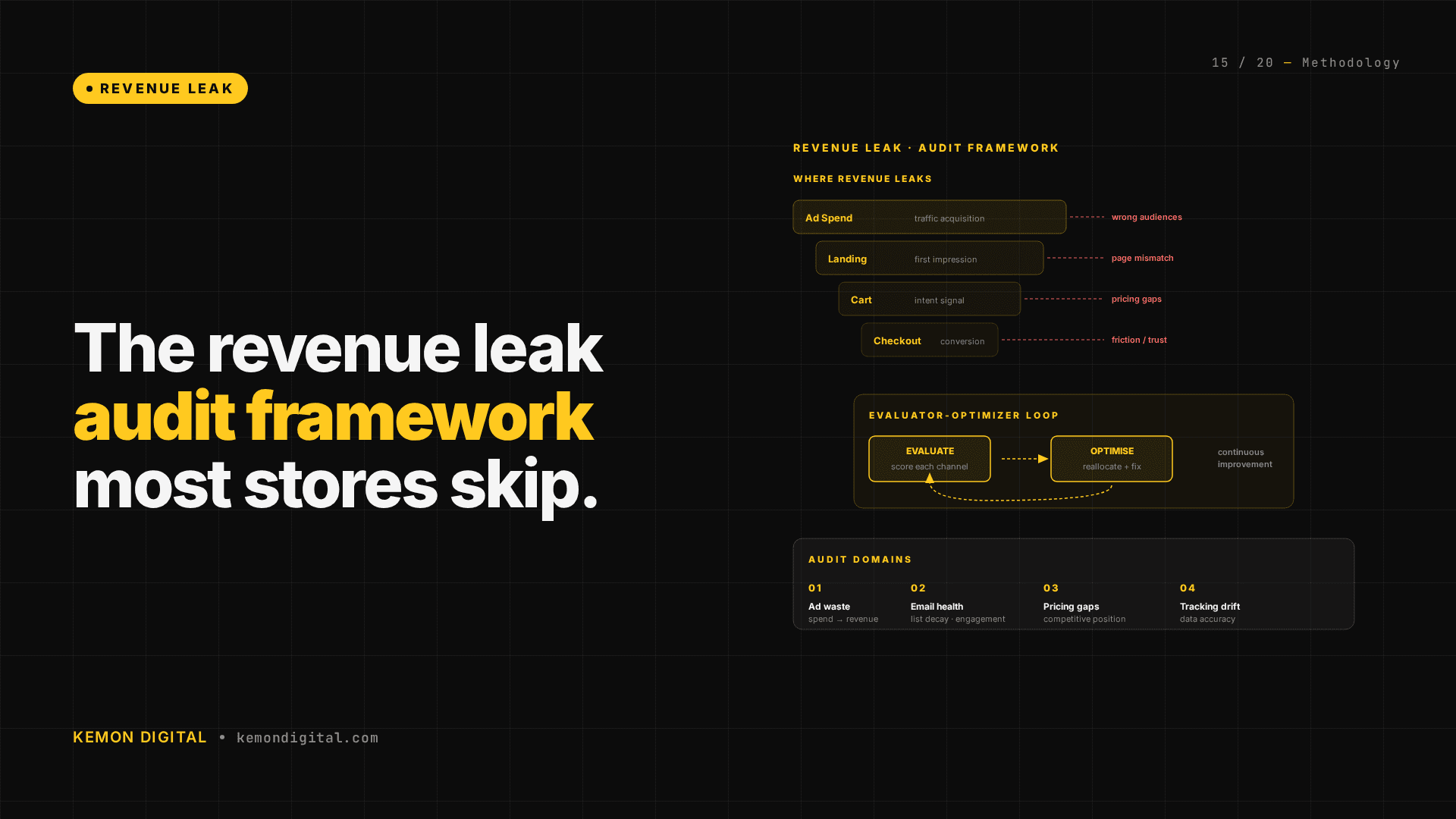
This audit follows what Anthropic's agent design research calls the evaluator-optimizer pattern. It's a two-phase approach that separates diagnosis from action:
Phase 1: Evaluate. Audit the current state systematically. Don't fix anything yet. Map every revenue leak — active and passive — with data. This is the evaluator's job: produce a complete picture of what's happening and what's not happening.
Phase 2: Optimise. Act on the evaluation. Pause the zero-conversion campaigns. Clean the email list. Restructure the ad groups. Reactivate the dormant contacts. Each action is informed by specific findings from Phase 1.
The principle: separate "what's wrong" from "fix it." Most teams try to do both simultaneously and end up doing neither well. They spot a bad campaign and pause it without understanding the pattern. They clean an email list without first mapping the viable audience.
When you separate the phases, the optimisation step is faster and more targeted because it's informed by a complete evaluation — not a partial view.
The Audit Framework
Here's the framework we run for every new e-commerce engagement. It's designed to surface both active and passive leaks in a single pass.
Google Ads audit:
- Pull the full search term report for the last 90 days.
- Cross-reference every search term against conversion data — which terms produced purchases, which produced clicks but no conversions, which produced nothing.
- Identify ad groups with zero conversions over the reporting period.
- Calculate the percentage of total spend going to zero-conversion ad groups.
- Review DSA campaigns separately — are they matching to relevant queries?
- Build a negative keyword list from irrelevant search terms.
- Restructure surviving campaigns by product category.
Email audit:
- Export the full contact list with engagement metadata (last open, last click, last purchase, signup source).
- Identify bot patterns: unusually high open rates with zero clicks, bulk signups from similar timestamps, invalid domain patterns.
- Segment by viability: active buyers, engaged non-buyers, dormant-but-valid, invalid, bots.
- Check domain authentication: DKIM, SPF, DMARC records.
- Calculate the real addressable audience vs. the headline list size.
- Map reactivation potential: how many dormant contacts have purchase history?
Cross-channel synthesis:
- Are you advertising products that your email campaigns are also promoting? Is the messaging consistent?
- Are your best-converting ad campaigns targeting segments that your email programme ignores?
- Are there customer segments visible in order data that neither ads nor email are targeting?
The cross-channel questions are where the passive leaks surface. They require looking at ads, email, and orders together — which is why they're typically missed when each channel is audited independently.
Why This Keeps Happening
Revenue leaks at this scale are not a competence problem. They're an infrastructure problem.
The platform had grown. Campaigns were launched to meet immediate needs — a seasonal push, a new product category, a competitive response. Each one made sense at the time. But nobody went back to evaluate whether they still made sense six months later, because the reporting infrastructure wasn't designed for that retrospective view.
The email list accumulated over years. Every checkout, every popup, every partner integration added contacts. The list grew, but list hygiene didn't grow with it. By the time anyone looked closely, the signal-to-noise ratio had collapsed.
This is the pattern in nearly every e-commerce operation we've audited. The leaks aren't failures of execution — they're gaps that emerge when a business scales faster than its measurement and optimisation infrastructure.
Making It Repeatable
The difference between a one-off audit and a system is the feedback loop.
We've built the audit framework into our agent system so it runs on every engagement and on a regular cycle for ongoing clients. The evaluator agent produces a structured findings document. The optimizer agent generates a prioritised action plan. The feedback agent captures which actions were implemented and what the results were — so the next cycle's evaluation is smarter.
This is what turns a one-off heroic effort into a repeatable system. The framework improves with every run because the feedback loop tells it which patterns matter and which are noise.
FAQ
Q: Is 60%+ of ad spend going to zero-conversion campaigns normal?
A: It's more common than most operators realise, especially when DSA campaigns run without negative keyword strategies. The percentage varies, but finding 30-60% of spend on zero or near-zero conversion campaigns is typical in accounts that haven't been audited recently.
Q: How long does a full audit take?
A: The data pull and analysis takes a day. The cross-channel synthesis takes another half-day. Action planning is a few hours. Total: roughly two days for a complete evaluation. The optimisation phase (implementing changes) is typically a week.
Q: Should I pause zero-conversion campaigns immediately?
A: Pause the ad groups, not the campaigns. Some campaigns contain both high-performing and zero-performing ad groups. Pausing at the ad group level preserves the performing segments while cutting the waste.
Q: How often should I re-run this audit?
A: Quarterly for the full framework. Monthly for the quick checks (search term report review, email bounce rate monitoring, spend-to-conversion ratio by ad group). The quarterly cadence catches the slow leaks; the monthly cadence prevents new ones from accumulating.
Q: Can I do this without AI?
A: Absolutely. The framework is the same whether you run it manually or with agents. AI makes it faster and more repeatable, but the analytical logic — separate evaluation from optimisation, cross-reference between channels, build feedback loops — works with spreadsheets and human analysts. AI just means you can run it weekly instead of quarterly.