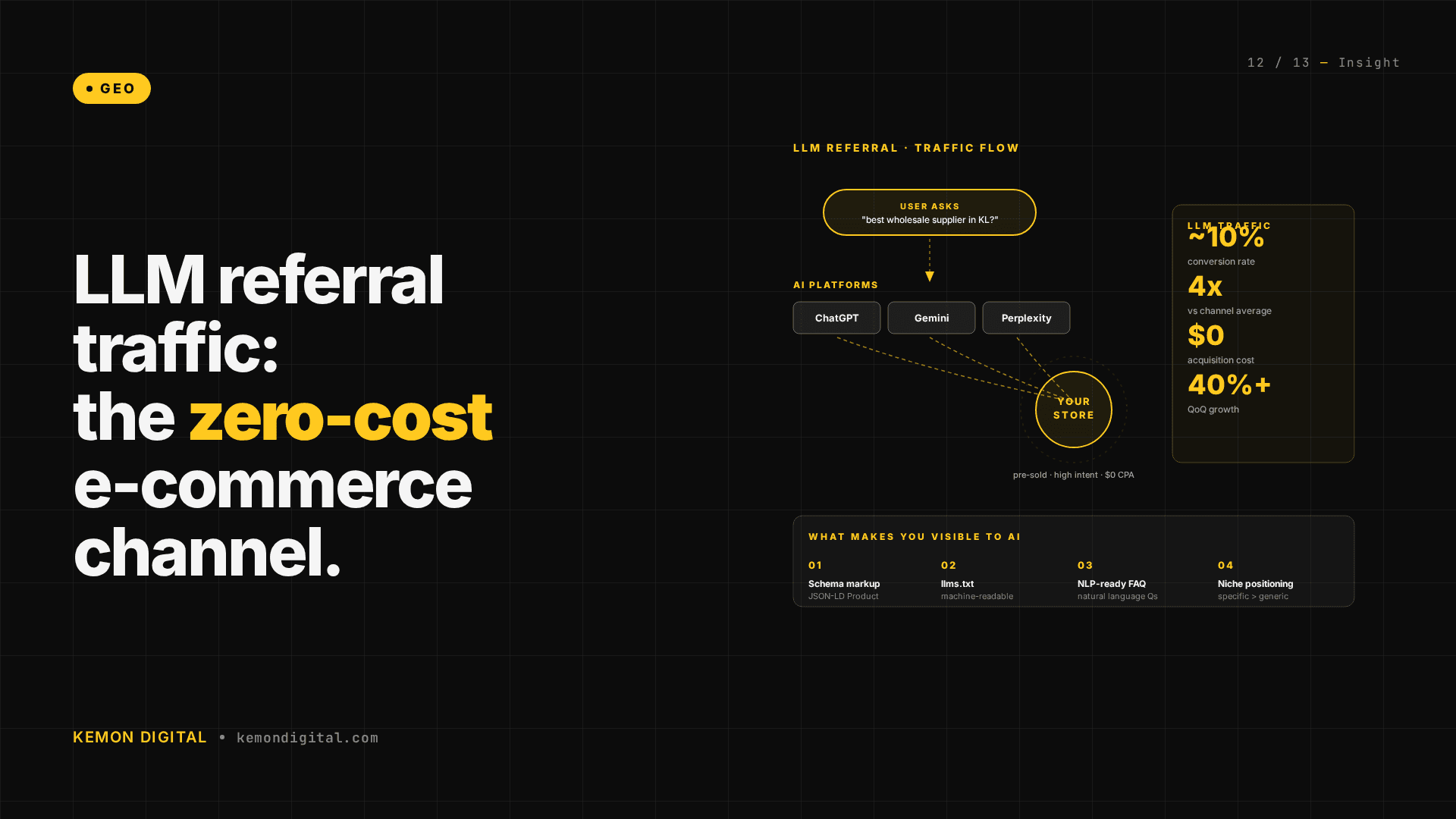
LLM Referral Traffic: The Zero-Cost E-Commerce Channel You're Probably Not Tracking
LLM Referral Traffic: The Zero-Cost E-Commerce Channel You're Probably Not Tracking
Keywords: llm referral traffic ecommerce, generative engine optimization, chatgpt referral conversion, ai traffic ecommerce channel
Introduction
There is a traffic channel growing over 40% quarter-over-quarter that most e-commerce teams are not tracking. Not because they chose to ignore it — because their analytics setup was built before it existed.
LLM referral traffic — visitors arriving from ChatGPT, Gemini, Perplexity, and other AI platforms — is converting at rates that outperform most paid channels. And it costs nothing.
We discovered this during a routine analytics audit for a B2B grocery platform. AI referral sessions were quietly converting at roughly 10%, outperforming both organic search and direct traffic. About half a dozen sessions per day, completely organic, from zero effort. The platform had done nothing to optimise for it. The AI just understood what the store sold and recommended it.
This article explains what LLM referral traffic is, why it converts so well, how to track it in GA4, and what to do about it before your competitors figure it out.
What Is LLM Referral Traffic?
When someone asks ChatGPT "where can I buy wholesale groceries in Klang Valley" or asks Perplexity "best B2B food supplier Malaysia," the AI reads your website, evaluates your product catalogue, and may recommend your store directly in the conversation. If the user clicks through, that's an LLM referral.
This is fundamentally different from organic search. In organic search, Google shows you a list of links and the user decides. In an LLM conversation, the AI makes a recommendation — often a single, confident one. The user arrives pre-sold.
That's why the conversion rates are so high. The visitor didn't browse ten options. They were told "this is the one."
The Numbers: Why This Channel Matters
The data across the industry is consistent:
- LLM-referred visitors who engage with on-site AI convert at nearly 10% — roughly 4x the average channel conversion rate
- LLM traffic has the second-highest engagement rate of any e-commerce channel, behind only SMS
- AI-referred traffic was up over 800% year-over-year on Black Friday 2025
- Shoppers arriving from AI platforms are nearly 40% more likely to purchase than average visitors
And the kicker: the cost per acquisition is zero. No ad spend. No content distribution cost. No bidding.
For context, most e-commerce paid channels operate at a 1-3% conversion rate with a meaningful cost per click. LLM referral traffic converts at 3-5x that rate with no acquisition cost. The economics are not comparable.
Why Most Teams Miss It
LLM referral traffic doesn't show up where you expect in GA4. Here's why:
Referral source fragmentation. ChatGPT traffic can appear as chatgpt.com, chat.openai.com, or just openai.com. Gemini traffic appears as gemini.google.com or gets bucketed into Google's organic traffic. Perplexity shows as perplexity.ai. Without custom channel groupings, these get scattered across "Referral," "Organic," or "(Other)."
Low volume, high signal. In the early stages, you might see single-digit daily sessions. That's easy to dismiss. But when those sessions convert at 10%, single-digit volume produces measurable revenue. Six sessions a day at 10% conversion is more than half a purchase daily — from a channel you're not paying for and not optimising.
No UTM parameters. LLM traffic doesn't carry UTMs. The AI doesn't tag its links. So standard campaign tracking is blind to it.
How to Track LLM Referral Traffic in GA4
Setting this up takes under fifteen minutes.
Step 1: Create a custom channel group. In GA4, go to Admin → Channel Groups → Create New. Name it "LLM Referral" or "AI Referral."
Step 2: Define the source conditions. Add rules for known LLM referral sources:
- Source contains
chatgpt.comORchat.openai.comORopenai.com - Source contains
gemini.google.com - Source contains
perplexity.ai - Source contains
claude.ai - Source contains
copilot.microsoft.com - Source contains
you.com
This list will grow. Review it quarterly and add new AI platforms as they emerge.
Step 3: Apply the channel group to your reports. Replace the default channel grouping in your acquisition reports with your custom group. LLM referral traffic now has its own row.
Step 4: Set up an exploration. Build a free-form exploration with dimensions: Session source, Landing page. Metrics: Sessions, Engaged sessions, Conversions, Revenue. Filter to your LLM Referral channel group. This shows which pages AI platforms are sending traffic to and how that traffic performs.
What Makes a Site Visible to LLMs?
This is where the actionable work lives. LLMs don't rank pages the way Google does. They don't care about backlinks, domain authority, or page speed. They care about structured, readable, unambiguous content that they can parse and recommend with confidence.
Here's what we've observed matters:
Clear product taxonomy. If your product categories are clean and descriptive, the LLM can understand what you sell. If your categories are internal codes or ambiguous labels, the LLM skips you.
Structured product pages. Product name, description, price, availability, specifications — all in clean HTML with semantic markup. Schema.org Product markup is ideal. JSON-LD structured data is how you speak to machines.
Niche positioning. LLMs are more likely to recommend specialists than generalists. "Wholesale grocery supplier for F&B businesses in Klang Valley" is a recommendation the AI can make confidently. "We sell everything" is not.
An llms.txt file. This is the emerging equivalent of robots.txt for AI. It tells LLM crawlers what your site is about, what pages matter, and what you want them to understand. We've started deploying these for clients. The specification is at llmstxt.org.
FAQ sections with natural-language questions. LLMs generate answers from content that matches how humans ask questions. A well-structured FAQ section — "Where can I buy wholesale rice in Malaysia?" — is exactly the content pattern LLMs pull from.
GEO vs SEO: What's Different
GEO — Generative Engine Optimization — is the emerging discipline of optimising for AI recommendation, not search ranking. The two overlap but diverge in important ways.
SEO optimises for a list of links. Your goal is to rank on page one so the user sees you alongside nine competitors. Click-through rates range from 1-10% depending on position.
GEO optimises for a single recommendation. Your goal is to be the answer the AI gives. There is no page one. There is no "position two." You're either the recommendation or you're invisible.
SEO rewards authority signals — backlinks, domain rating, page speed. GEO rewards clarity signals — structured data, unambiguous product descriptions, niche positioning, schema markup.
SEO is competitive and expensive. Ranking for "wholesale groceries Malaysia" against established players requires months of content and link building. GEO is wide open. Most e-commerce sites have not optimised for AI readability. The first mover advantage is real and the window is closing.
What We Changed for Our Clients
When we discovered LLM referral traffic in the B2B grocery platform's analytics, we made four changes:
1. Deployed llms.txt. A machine-readable summary of what the store sells, who it serves, and what pages to prioritise. Took under an hour.
2. Added JSON-LD Product schema to all product pages. Structured data that tells any machine — Google, ChatGPT, Perplexity — exactly what each product is. Price, availability, brand, category. No ambiguity.
3. Rebuilt the FAQ section with natural-language questions. We wrote the questions the way a customer would ask ChatGPT. "Where can I buy wholesale cooking oil in KL?" not "Product Category: Cooking Oil."
4. Created a custom GA4 channel group. So we could track LLM referral traffic separately and measure the impact of the above changes over time.
These are not expensive changes. No ad spend. No new tools. Just making the existing site readable to a new class of visitor — AI platforms that recommend products on behalf of their users.
The Window Is Closing
LLM referral traffic is growing at 40%+ quarter-over-quarter. AI crawlers now outnumber traditional search bots on many e-commerce sites. Every major platform — Shopify, Google, Microsoft — is building infrastructure for AI-mediated commerce.
The stores that structure their content for AI readability now will compound that advantage as LLM traffic scales. The stores that wait will find themselves invisible to a channel that their competitors are already benefiting from.
The best part: this is not a "spend more" play. It's a "structure better" play. The investment is engineering time, not ad budget. And the returns compound because once an LLM learns to recommend you, it keeps doing so until a better-structured competitor shows up.
FAQ
Q: How much LLM referral traffic should I expect?
A: It depends on your niche. We've seen single-digit daily sessions for niche B2B stores and meaningfully higher for consumer brands. The volume is small compared to organic search — but the conversion rate is 3-5x higher. Track it separately and evaluate on revenue per session, not session volume.
Q: Does this only work for e-commerce?
A: No. Any business that can be recommended by an AI benefits from GEO. Service businesses, SaaS, local businesses, content publishers. If someone might ask an AI "who should I hire for X" or "what's the best tool for Y," you want to be the answer.
Q: Will LLM traffic replace organic search?
A: Not in the near term. But it's growing fast enough to become a meaningful channel within the next twelve to eighteen months for most e-commerce businesses. The play is not to abandon SEO — it's to add GEO as a parallel discipline. Most of the work (structured data, clear content, schema markup) benefits both.
Q: How do I know if AI crawlers are visiting my site?
A: Check your server logs for user-agent strings containing GPTBot, Google-Extended, ClaudeBot, PerplexityBot, Bytespider, or CCBot. If you use Cloudflare, the Bot Analytics dashboard surfaces this automatically. If these bots are visiting, LLMs are already reading your content.
Q: Is there a risk in optimising for LLMs?
A: The main risk is over-optimising for machines at the expense of human readability. The good news is that the changes that help LLMs — structured data, clear descriptions, natural-language FAQs — also help human visitors. There's no trade-off. Structure benefits everyone.
Q: What about sites behind paywalls or login walls?
A: LLMs cannot read content behind authentication. If your product pages require login to view, you're invisible to AI recommendations. Consider making at least your product catalogue pages publicly accessible, even if checkout requires authentication.