The Most Expensive Gap in Luxury E-Commerce Isn't Traffic — It's the Last Step of Checkout
The most expensive gap in luxury e-commerce isn't traffic — it's the last step of checkout
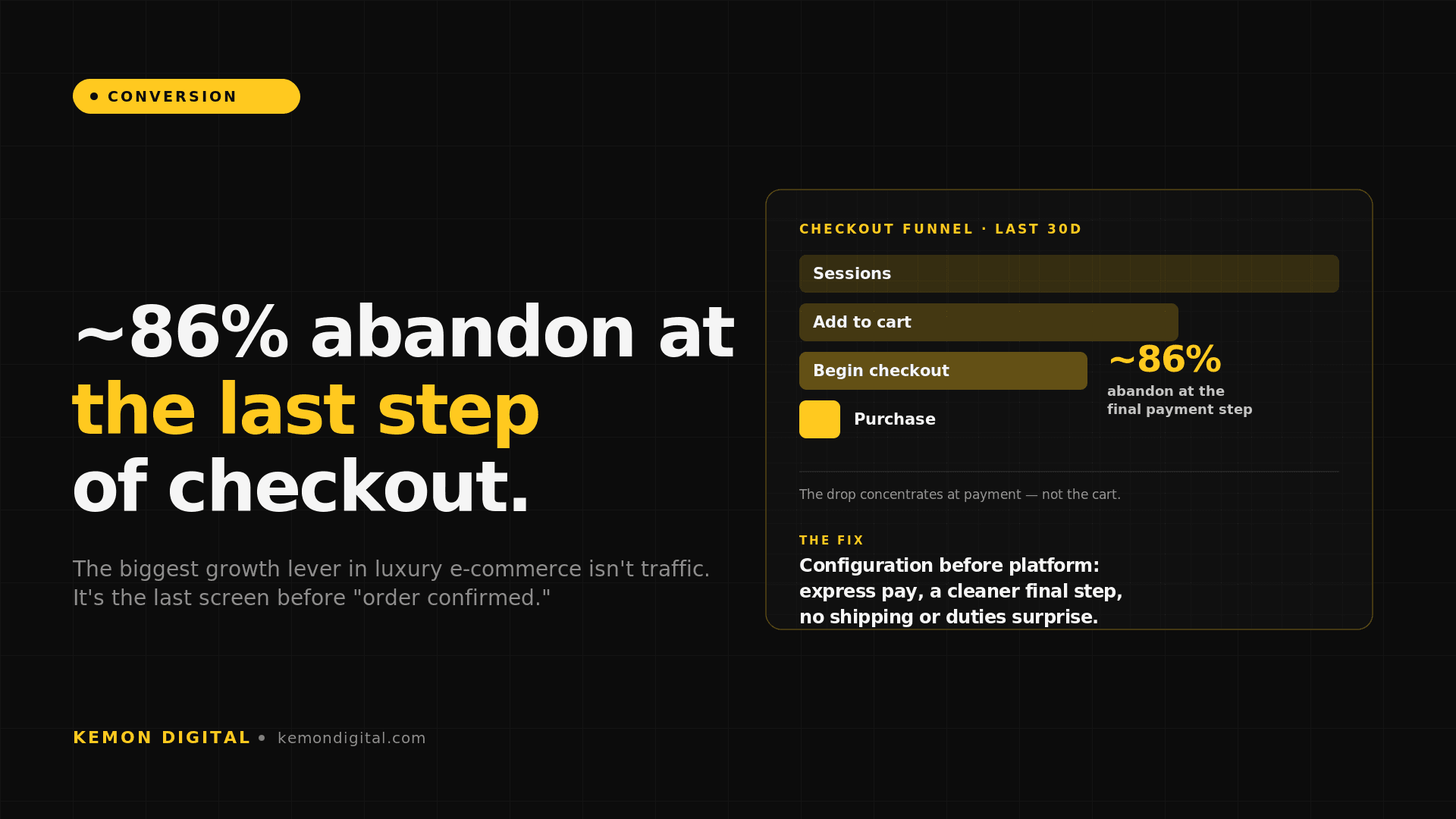
If you run a luxury e-commerce storefront, the most valuable growth lever in your business probably isn't another ad campaign. It's the last screen before "order confirmed." On a storefront doing seven-figure monthly GMV, we found that around 86% of shoppers who start checkout never finish — and almost all of that loss happens at the final payment step, not the cart.
That's not a demand problem. It's a measurement blind spot at the bottom of the funnel, where almost no one is looking.
Why checkout is invisible to most teams
Most storefront platforms report conversion as a single number, not a funnel. So the drop between "begin checkout" and "purchase" — the most expensive gap in the business — never shows up on a dashboard. As a catalogue and market mix grow, the checkout configuration quietly falls behind the volume flowing through it. The traffic metrics still look healthy. The leak stays hidden.
What the funnel actually showed
When we built the checkout funnel out step by step, the picture was stark: the large majority of people who began checkout dropped before paying. Three signals told us this was friction, not disinterest.
The drop concentrated at the final payment step — people reached the point of paying and stopped. The retailer's automated abandonment emails were already recovering a six-figure monthly sum, which means the intent was real and the storefront was leaking it. And one collection page had been converting at effectively zero for several cycles — a template that hadn't kept pace with the catalogue, quietly sending paid traffic into a dead end.
Run the math like a CFO and each single percentage point of checkout completion you recover is worth a low-five-figure monthly sum. Recover a handful of points — entirely realistic from a leaky baseline — and it annualizes into the high six figures. No ad optimization comes close.
The fix: configuration before platform
The instinct is to commission a redesign or re-platform. We did the opposite and shipped the free, configuration-level wins first:
- Express checkout. The platform already included one-tap express pay that wasn't fully deployed. For returning luxury buyers on mobile, removing the form is often the single biggest lift available.
- A cleaner final step. Fewer fields, clearer error states, and trusted payment options visible at the moment of hesitation.
- No cost surprise. A large share of luxury checkout abandonment is unexpected shipping and cross-border duties. We surfaced "duties paid" and the shipping position before the final step.
- Reconnect the dead page. The zero-converting collection was routed to an in-stock-first template so paid traffic landed somewhere that could convert.
Only after the free wins did we line up the optional paid layer — a checkout-extension app to A/B test against the native flow.
FAQ
Q: What's a "good" checkout completion rate for luxury e-commerce? A: Benchmarks vary, but a healthy storefront should retain well above the low-teens completion rate we often see on un-optimized luxury checkouts. The more useful question isn't the absolute number — it's whether you're measuring the begin-checkout → payment → purchase steps separately at all. If your platform collapses them into one figure, you can't see the leak.
Q: Should I redesign my checkout or re-platform to fix abandonment? A: Usually not first. The highest-ROI fixes are configuration-level: turning on express pay, simplifying the final step, and removing shipping/duties surprise. These are typically free and deliver the biggest lift. Pilot paid apps or re-platforming only after you've captured the free wins.
Q: Why does abandonment concentrate at the payment step specifically? A: It's usually friction and trust — unexpected cost, too many fields, or missing express options at the exact moment of payment. Shoppers with real intent stall when the final step adds work or surprise, not because they lost interest.
Stop optimizing the top of the funnel
The uncomfortable truth for most luxury brands is that the most expensive gap isn't at the top of the funnel where everyone is looking. It's at the bottom, on the last screen, where almost no one is measuring.
Want to know where your checkout is leaking? Kemon runs an AI-driven checkout and conversion audit that maps your funnel step by step and prioritizes the fixes by revenue impact. Talk to us →