Your Best Ad Campaign Is the One You've Been Capping
Your best ad campaign is the one you've been capping
The cheapest growth in a paid media account isn't hiding in the losers you keep trying to fix. It's sitting inside the winners you've quietly been throttling — campaigns spending right up against a daily cap they could blow past tomorrow.
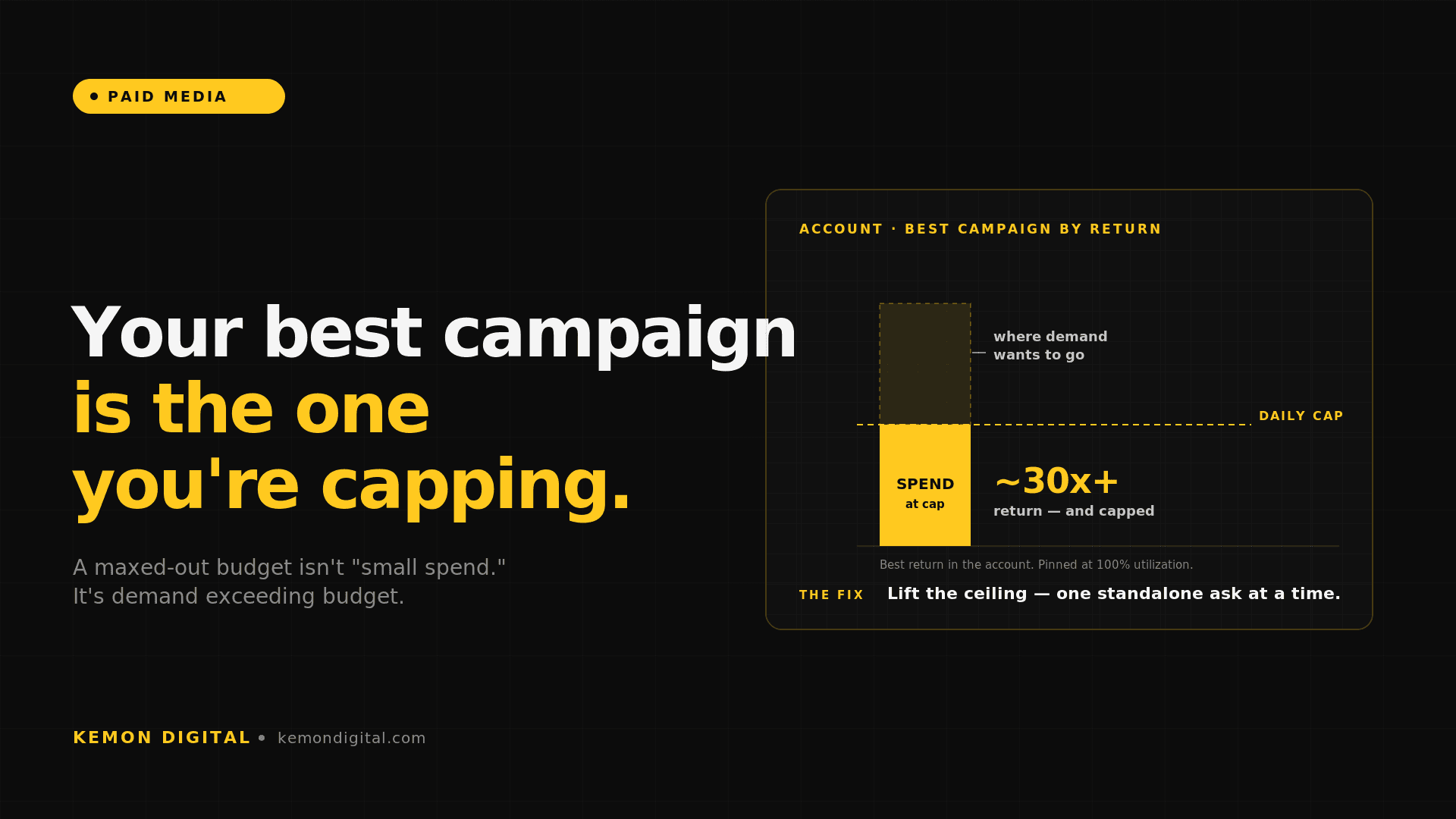
On a luxury retailer we work with, the single best performer in the entire account — returning north of 30x — was capped near full utilization and treated as a minor line item. The most efficient money in the business was the one pound it had decided, by leaving an old cap in place, to stop spending more of.
Why winners hide
Mature accounts pull attention toward problems. Weak returns, ad sets that won't stabilize, fatigued creative — those get the meetings and the rebuilds. It feels like work because it is work. But fixing a loser, even when it works, moves a small number from bad to mediocre.
Meanwhile a throttled winner produces a quiet, well-behaved number that never asks for attention. On a summary view, a campaign with a tiny daily budget reads as a rounding error — small spend, easy to scroll past. Decompose it and the picture can invert: that "small" budget running at near-full utilization, behind the best return in the account.
A maxed-out cap is a buy signal
A campaign sitting flush against its daily ceiling is not telling you it's done. It's telling you the opposite: demand exceeds budget. The cap is the only thing between the current spend and more revenue at the same return. Every day it stays capped, the business leaves that day's incremental return on the table — and never sees it.
On this account it wasn't isolated. Several proven winners were pacing right at the edge of their caps, occasionally tipping over — each a campaign the market was actively asking to fund more aggressively. The reallocation discipline simply hadn't been built into the workflow yet, so the signals sat unread cycle after cycle.
What we did: lift the ceiling, one ask at a time
We ranked the account by return and looked first at what was efficient and constrained — the winners pressing against their caps. Then we lifted those caps.
This is as close to free growth as a paid account offers: no new creative, no new audience research, no new landing page, no platform migration. The demand is already there and already converting at a known return. You're simply removing a ceiling you set when the campaign was smaller and unproven.
We were deliberate about framing. Rather than bundle the increases into one large "raise the budget" request — the kind that triggers a reflexive no — we presented each reallocation as a standalone ask, tied to that campaign's own return and utilization. A request to lift the cap on a campaign returning north of 30x that's been pinned at full utilization for weeks defends itself.
Only after the winners were un-throttled did we look at the underperformers — and the question was no longer "how do we rescue this," but "does this deserve budget at all, when the proven winners can still absorb more." Reallocation, not rescue.
FAQ
Q: How do I know if a campaign is capped versus just low-spend? A: Look at budget utilization, not budget size. A campaign spending at or near 100% of its daily cap every day is constrained — demand is exceeding the ceiling you set. A genuinely low-demand campaign won't spend its full budget. The intersection of strong ROAS and high utilization is your cheapest growth.
Q: Won't scaling a winner make its return collapse? A: It usually decays gradually, not instantly. That's why you lift caps in steps and watch the return over a short learning window, rather than uncapping everything at once. A winner you let breathe today is a larger, better-understood winner you can scale again next cycle.
Q: Why present each budget increase separately instead of one big request? A: A portfolio-wide "raise the budget" ask invites a reflexive no and forces an act of faith. A single cap-lift tied to one campaign's proven return and full utilization defends itself on its own evidence. Split the asks.
Stop throttling the winner you already have
The best campaign in most accounts is already running — it's just wearing a small budget. The work isn't to build a new winner. It's to stop throttling the one you already have.
Want to know which of your campaigns are efficient and constrained? Kemon runs an AI-driven paid-media audit that ranks your account by return and utilization and surfaces the cap-lifts worth making first. Talk to us →