When Half Your Revenue Has No Source — Fix Attribution Before You Spend Another Cent
When half your revenue has no source — fix attribution before you spend another cent
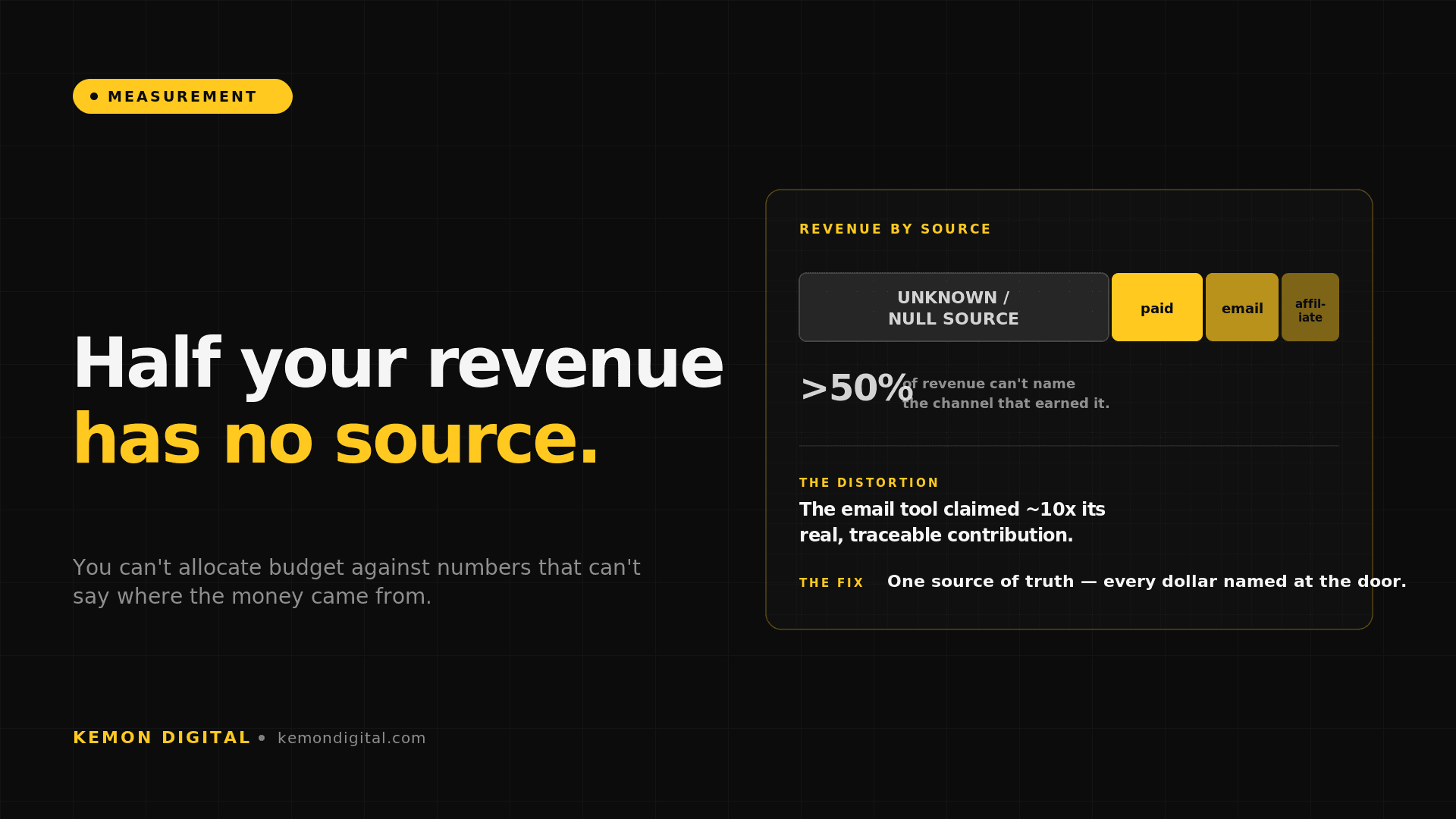
If you run a luxury e-commerce business, your budget is only as good as the data it stands on. On a storefront doing seven-figure monthly GMV, we found that more than half of all revenue arrived with no traceable source attached — a high-six-figure slice of monthly revenue that the dashboard could name as nothing at all. The budget was being allocated against numbers that, quite literally, could not say where the money came from.
That's not a demand problem. It's an attribution blind spot, and it outranks every campaign optimization on the list.
Why the blank hides in plain sight
The channel mix had grown faster than the tracking underneath it. Each new partner, tool, and market arrived with its own way of tagging links — or no tagging at all. Attribution hadn't been unified as the mix expanded, so the reporting layer quietly accumulated gaps no single dashboard surfaced.
That's the trap with attribution debt: nothing breaks. The revenue still lands, the totals still look right at the top, and the blind spots only appear when you try to answer the one question that decides every budget — which channel actually produced this?
What the data actually showed
We pulled revenue apart by source. Three findings reframed the entire spending conversation.
- The blank. More than half of all revenue carried no traceable source — a null tag where the channel should be. The largest "channel" in the business, by a wide margin, was unknown.
- The double-count. The email platform was crediting itself with roughly ten times the revenue that could actually be traced to it. Left unchallenged, that inflated number would have justified pouring more budget into a channel whose true return was a fraction of the headline.
- The ghost. A single affiliate partner turned out to be driving close to a tenth of all revenue — and it had been almost completely invisible, folded into the blank or miscredited elsewhere.
Put together, the account wasn't measuring its channels. It was measuring a story.
The fix: attribution as infrastructure
We treated attribution as infrastructure and rebuilt it before touching a single budget line.
- Enforce UTM discipline on every link. Every outbound link — email, social, affiliate, partner, marketplace — got a consistent, governed tagging scheme. No link ships untagged.
- Decompose the channel tags. We pulled apart the lumped-together source data so each channel reported its own traceable contribution, rather than letting tools self-credit.
- Add server-side tracking and durable identity. Browser-side tags drop traffic to ad blockers, privacy settings, and cross-device journeys. A server-side layer ties a purchase back to its origin even when the browser can't carry the tag the whole way.
The order mattered. We did not optimize spend, shift budget, or pause channels until the numbers underneath those decisions were trustworthy.
FAQ
Q: How much unattributed revenue is "normal" for an e-commerce store? A: Some leakage is expected — privacy settings and ad blockers strip tags. But when a meaningful slice, let alone more than half, of revenue arrives with no source, that gap outranks every campaign optimization on your list. Measure your blank bucket first; it's usually larger than teams assume.
Q: Why does my email or ad platform report more revenue than I actually traced? A: Native platform reporting almost always over-credits the platform — it claims any sale that merely touched the channel. Reconcile each channel's self-reported revenue against what you can independently trace, and treat that gap as the real number.
Q: Do I need server-side tracking, or is UTM tagging enough? A: Governed UTM tagging is the first move and shrinks the blank immediately. But browser-side tags still drop to ad blockers and cross-device journeys. A server-side layer with durable identity is what makes attribution survive those gaps.
Stop allocating against a story
The uncomfortable truth is that most spending decisions are made against numbers nobody has audited. When more than half of revenue is unattributed, one tool overstates itself tenfold, and a tenth of the business is invisible, no amount of media optimization on top of that data can be trusted.
Want to know how much of your revenue is flying blind? Kemon runs an AI-driven attribution and measurement audit that maps your revenue back to its real sources and prioritizes the fixes by impact. Talk to us →