We Put Our Own Retainer on Trial Inside the Client's Dashboard — Here's Why
We put our own retainer on trial inside the client's dashboard — here's why
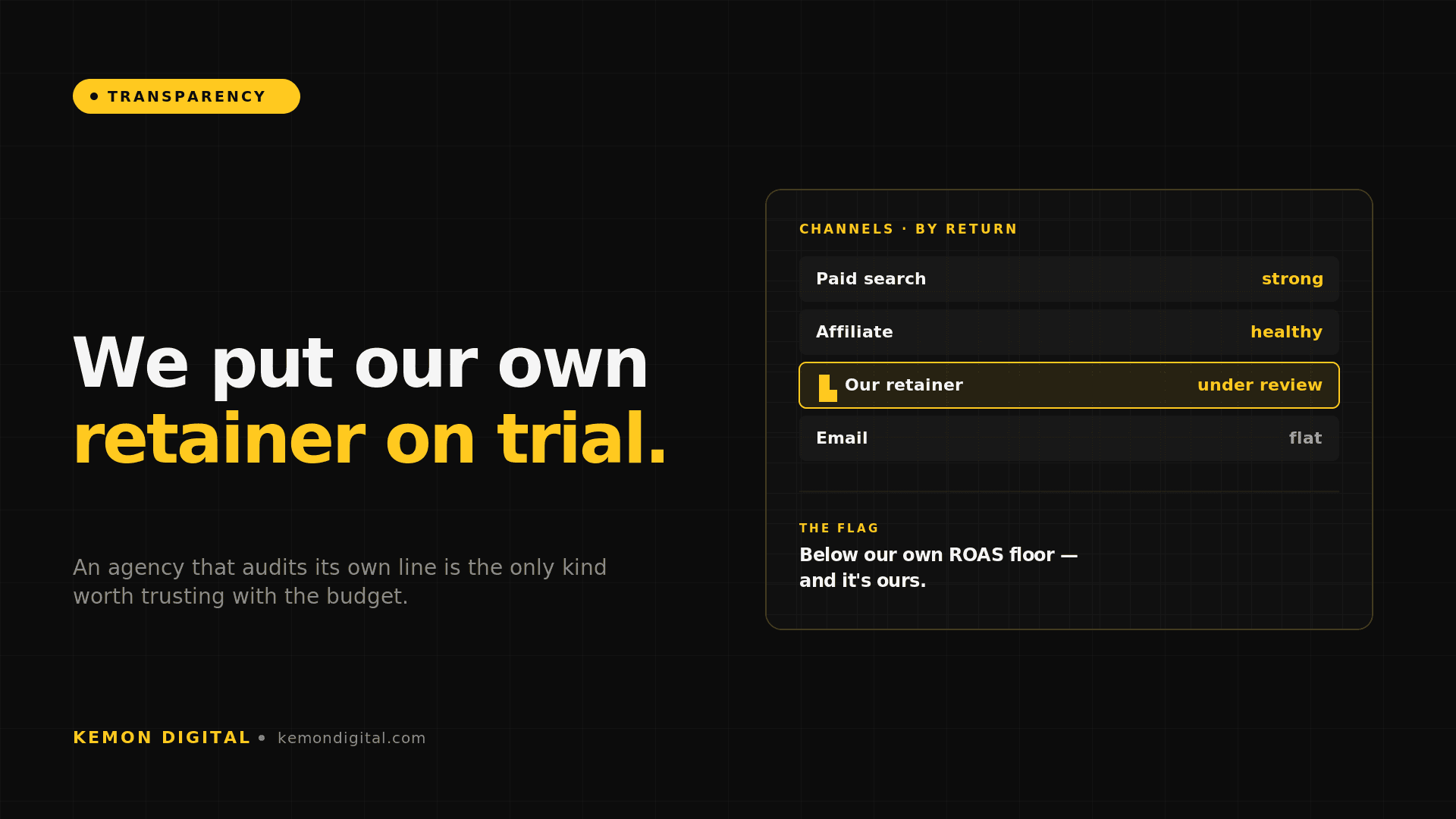
If you run a marketing agency, or you're choosing one, the most valuable thing you can put in front of a client isn't a good number. It's a number the client knows wasn't massaged. Our AI analysis system read the whole business of a luxury e-commerce client and flagged a channel returning below our own performance floor. The awkward part: that channel was partly ours. We left the flag on the table, in the client's own dashboard, where they could see it.
Why most agencies never surface this
Most agencies report on everything except their own line. The deck covers campaign performance, channel ROAS, funnel health — every number that reflects on the work, framed by the people whose work it reflects on. The one figure that rarely makes the slide is the agency's own contribution measured against its own standard.
The conflict is structural: the party doing the work also controls the framing of the work. A channel-by-channel report written by the agency, for the agency to present, will almost never surface a flag against the agency.
What the AI layer found
We run an AI layer across the entire business that reads channel by channel with a finance lens — not "did this campaign do well" but "does this line earn its place in the budget," the question a CFO would ask in every review. The point is that it doesn't know whose feelings are on the line. It just reads the numbers.
On one pass, the system flagged a channel returning below the performance floor we hold ourselves to. Then we read which channel it was. Our own retainer was attached to the line the system had just marked as underperforming against our own standard.
This is the moment that defines an agency. There are two honest paths and they diverge hard:
- Filter the flag before the review — adjust the lens, re-segment the channel, find the framing where the number looks acceptable, and present a clean deck. Nobody would ever know.
- Let the number stand in the client's own dashboard, name it out loud, and let it sit there being uncomfortable.
What we did
We left it in. The flag against our own retainer stayed in the client's dashboard, visible to them, named in the review.
Then we did the unglamorous part: we treated our own line by exactly the same rule we apply to everyone else's. No defensive re-segmentation to make an underperforming line look better. We put the number on the table, owned it, and made the same call we'd make on any other channel below the floor — examine it, fix what's fixable, and if it can't clear the bar, say so plainly.
The framing matters: the point isn't self-flagellation. An agency theatrically beating itself up is just a different kind of performance. The point is that the same instrument runs over every line, ours included, and its output reaches the client unfiltered.
FAQ
Q: Why would an agency show a client a flag against its own retainer? A: Because trust is built by making the uncomfortable number visible, not by hiding it. A performance floor that applies to client channels but never to the agency's own line isn't a standard — it's a marketing claim. The agency willing to be measured by the same rule is the one that has earned the rest of the budget.
Q: What is a "performance floor" in this context? A: It's the return threshold below which we'd tell any client a line isn't pulling its weight. The discipline is applying that same threshold to every line — including the agency's retainer — and using a lens that doesn't know whose line it's reading.
Q: How do you measure your own line objectively? A: With an AI layer that reads the business channel by channel with a CFO's lens, without the conflict of interest a human-built deck carries. It surfaces the uncomfortable line that interested-party reporting is built to smooth over — and we leave its output untouched in the client's own view of the data.
Trust isn't built by hiding the awkward number
When you let your own line be measured by the same standard you hold everyone else to — in the client's own view of the data rather than a curated deck — the conversation changes. The client stops wondering what the deck isn't showing them. The budget conversation becomes a shared read of one honest dataset.
Want an agency that puts its own line on trial? Kemon runs an AI-driven, CFO-lens audit across every channel in your business — ours included — and leaves the output unfiltered in your own dashboard. Talk to us →