Insight Is Cheap. Execution Is the Bottleneck — The PIC Test
Insight is cheap. Execution is the bottleneck — the PIC test
If your team generates more insight than it ships, you're not short on ideas — you're short on execution. Most analysis doesn't fail because the insight is wrong. It fails because no one in the room can actually do it. We run every recommendation through a "PIC test": if no single person-in-charge can do it next week with the tools they already have, it's not an action — it's an escalation or an idea.
The cheapest thing in any business is a good idea on a slide. The scarce thing is a person who can ship it next week.
Why good recommendations stall
We work with a multi-brand luxury retailer, and like most teams running real volume, the constraint was never a shortage of ideas. Every cycle produced a healthy stack of recommendations — pause this, scale that, fix the other thing. The deck looked sharp. The intent was real.
But cycle over cycle, a familiar gap opened up between what got recommended and what got done. Plenty of good thinking arrived on the page and then quietly stalled. Nobody was dropping the ball — the work simply hadn't been sorted by who could actually move it.
That's the part most analysis skips. We treat "here is the insight" as the finish line, when it's barely the starting gun. The hard question isn't what should happen — it's who, specifically, can make it happen, and with what they already have in hand.
What the filter revealed
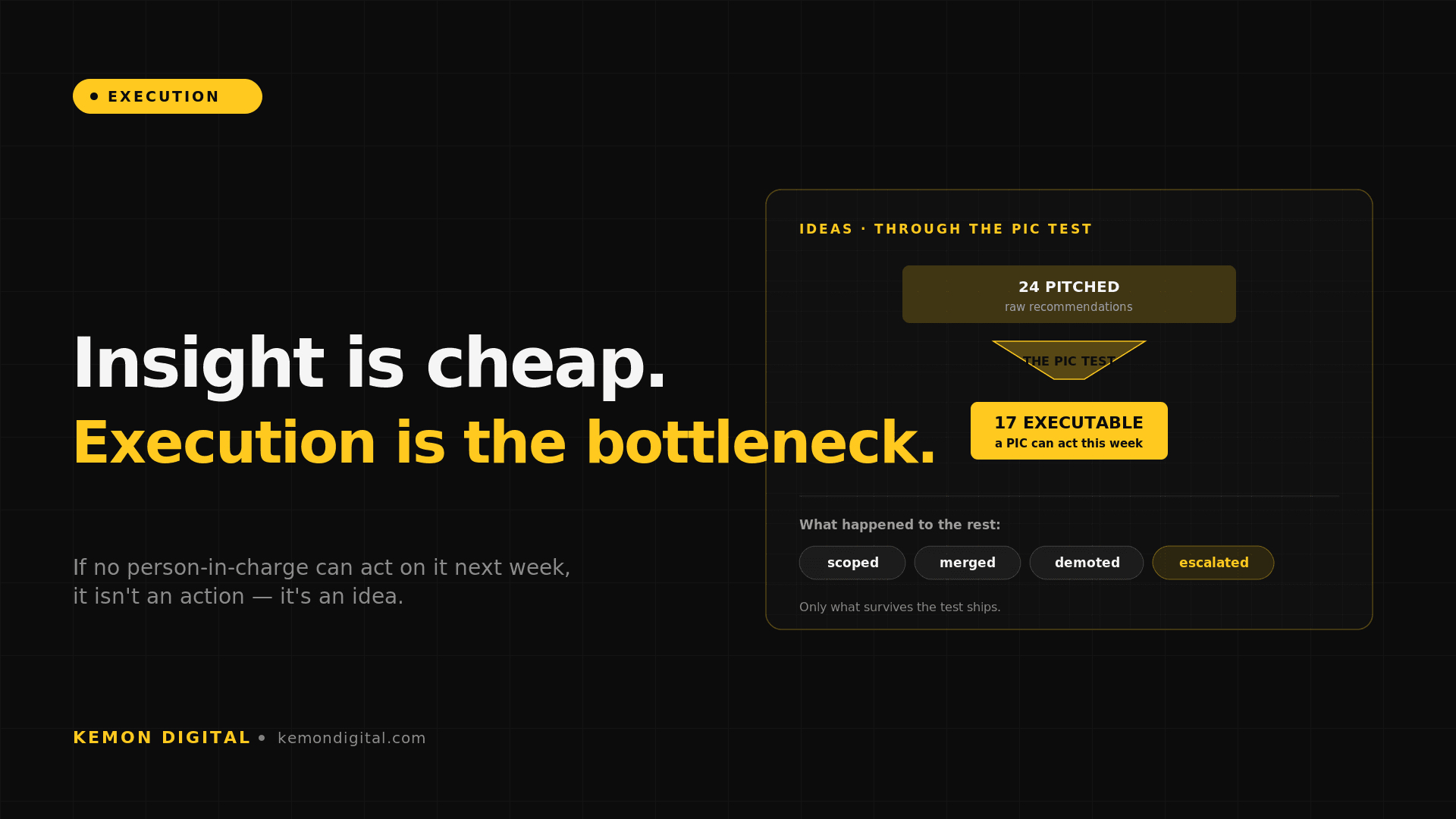
When we audited a stack of around 24 pitched recommendations against a single filter, the picture got honest fast. The filter is one question: does a single named person-in-charge have the authority to execute this next week, using tools they already control? If yes, it's an action. If no, it's something else wearing an action's clothes.
Three failure modes showed up immediately:
- The disguised escalation. A recommendation that reads like a task but actually requires sign-off no operator in the room holds — a budget ceiling, a contract change, a pricing call. That's a decision someone else has to make, and labelling it "to-do" just buries it.
- The latent idea. Genuinely good thinking that has no owner, no tool, and no next step yet. Worth keeping — not worth pretending it's executable this cycle.
- The redundant or oversized item. Several recommendations were really the same move described twice, or one move so broad it could never start. These needed merging or scoping down first.
After the filter, the 24 became 17 truly executable actions. The other seven didn't vanish — they got relabelled honestly: a few escalated to the decision-maker, a couple merged into sharper single actions, one or two scoped down to a first step, and the rest parked as ideas with no owner yet.
The fix: make the PIC test a standing gate
We made the PIC test a gate every recommendation passes through before it's allowed to call itself an action. Three rules:
- Name the person, not the team. "Marketing should test this" is not an owner. "The performance lead can change this cap on Monday" is. If you can't name one human with the authority, it isn't an action yet.
- Check the tools they already hold. If executing it needs a new tool, a new integration, or someone else's password, it's a project — and projects get escalated and resourced, not slipped into a weekly action list.
- Label honestly, then route. Every item lands in one of three buckets: executable now, needs authority, or latent idea. Nothing gets to hide in the gap between them.
The discipline that makes this work is being willing to mark items down. Demoting a recommendation from "action" to "escalation" feels like losing ground. It's the opposite — a demoted item now sitting on the right desk is far closer to shipping than an "action" no one could ever execute.
FAQ
Q: What is the PIC test? A: PIC stands for person-in-charge. The test is one question: can a single named person execute this recommendation next week, with the authority and the tools they already control? If yes, it's an action. If no, it's an escalation or a latent idea — useful, but not something that ships this cycle.
Q: Isn't marking a recommendation down a sign the analysis was weak? A: No — it's the opposite. Demoting an item to an escalation puts it on the desk that can actually move it. A recommendation routed honestly ships; a recommendation mislabelled as an action just waits. The executable count gets smaller but real, and execution rate climbs.
Q: Why name a person instead of a team? A: Because a team isn't an owner. "Marketing should test this" has no one accountable and no next step. Naming one human with the authority and the tools in hand is what turns intent into something that moves on Monday.
Sort for who can ship it
If your team generates more insight than it ships — and most do — the fix isn't more analysis. It's a gate. Run the PIC test on every item, sort into three buckets instead of one, and treat marking work down as progress.
Insight is cheap. It always has been. The bottleneck worth your attention is whether a real person can do the thing next week.
Want your recommendations turned into actions that actually move? Kemon runs an AI-driven analysis layer that filters every recommendation through the PIC test and routes it to the desk that can execute. Talk to us →