Efficient but Fragile — the Revenue Concentration Risks Hiding in a Healthy P&L
Efficient but fragile — the revenue concentration risks hiding in a healthy P&L
A business can look efficient on the surface and be dangerously fragile underneath. Revenue concentration is the reason: the same numbers that make a P&L look healthy often hide a handful of single points of failure — accounts and partners that, if any one of them paused, would take a chunk of the business with them. On a luxury retail client doing seven-figure monthly volume, we found three of these hiding in plain sight.
The dashboard looked great precisely because the risk wasn't on it.
Why concentration hides behind good numbers
When the top line is strong, nobody goes looking for the structure underneath it — and the structure is where fragility lives. As a business grows quickly, demand tends to concentrate faster than the business diversifies. That's a normal consequence of scaling, not a failure. But normal doesn't mean safe.
So we stopped reading the P&L as a scorecard and started reading it as a dependency map. Not "how much did we make?" but "what is each dollar resting on, and what happens if that thing pauses?"
The three concentrations the headline numbers hid
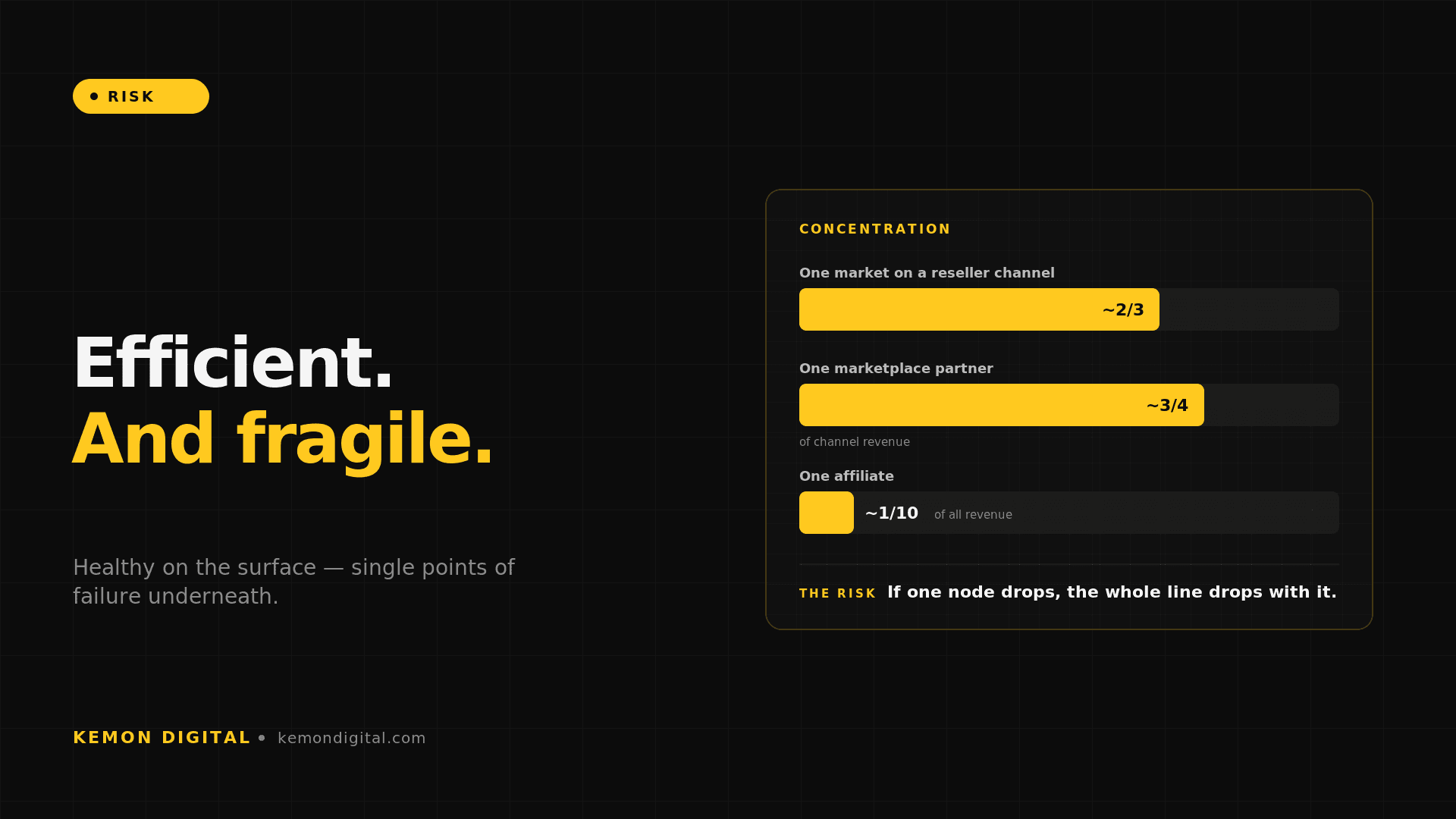
One market resting on a concentrated wholesale-reseller channel. In one market, a large and rising share of revenue ran through a concentrated wholesale-reseller channel — effectively a couple of accounts — climbing toward two-thirds of that market's revenue over successive cycles. Reported as topline, it looked like a star performer. Read as a dependency, it was a market whose health sat in the hands of a very small number of buyers who could change terms, slow orders, or stop entirely.
A single marketplace partner carrying most of marketplace revenue. Across the marketplace channel, roughly three-quarters of revenue flowed through one partner. Marketplace as a category looked like healthy diversification away from the owned storefront. Inside the category, it was one relationship doing nearly all the work — a single contract, a single algorithm, a single counterparty.
One affiliate partner making up about a tenth of all revenue. Quietly, a single affiliate partner accounted for around a tenth of total revenue — not a line anyone flags in a good month, but a tenth of the entire business depending on one program staying live, on its terms staying favorable, on it continuing to send traffic at all.
The through-line: efficient paid performance was masking all three. Strong return on ad spend made the operation look robust, which is exactly what kept anyone from asking the harder question — robust against what? A high-efficiency engine pointed at a concentrated base isn't resilient. It's a fast car with one bolt holding the wheel.
The fix: make the invisible visible
The work here isn't optimization — it's surfacing the risk and reframing it as something to be managed.
- Surface each concentration explicitly. We pulled each dependency out of the topline and named it as a standalone risk line. What gets measured as a risk gets managed as one; what stays buried in a healthy total gets ignored until it breaks.
- Run the pause test on each. For every concentration, one question: what happens to the business if this account, partner, or channel pauses tomorrow? The answers were consistently scarier than the dashboard implied — and that gap is the entire point.
- Treat diversification as risk management. Spreading the wholesale channel across more accounts, building direct demand to reduce single-partner reliance, broadening the affiliate base — these aren't growth experiments competing for budget. They're insurance on revenue that already exists.
- Use structural fixes where they exist. Some concentrations have structural answers — for example, building authenticated resale to reduce dependence on a narrow reseller channel while capturing demand directly. We framed those as resilience infrastructure, not side projects.
FAQ
Q: What is revenue concentration risk? A: It's when a meaningful share of your revenue rests on a single account, partner, channel, or algorithm — so that if that one thing pauses, a chunk of the business goes with it. It's especially dangerous because it hides behind healthy top-line numbers: efficient performance makes a concentrated base look robust until the day it isn't.
Q: How do I find concentration risk in a healthy-looking business? A: Read your revenue as a dependency map, not a scorecard. For every chunk of revenue, ask what it rests on — which account, which partner, which channel. Then run the pause test: if that one thing paused tomorrow, how much of the business would go with it? A pie chart that looks diverse at the category level often hides a single relationship inside each slice.
Q: When is the right time to diversify? A: While the numbers still look great. Diversification is cheapest to build before you're forced into it — spreading a concentrated channel, building direct demand, broadening partners. Treat it as insurance on revenue you already have, not as a growth experiment competing with other priorities.
Go looking before something forces you to
If your numbers look healthy, that's exactly when to do this. Efficiency hides concentration, and concentration is where the real risk lives. The dashboard is built to show you how much you made — not what would happen if one thing stopped.
Want to map where your revenue is concentrated? Kemon runs an AI-driven resilience audit that surfaces your single points of failure and prioritizes the fixes. Talk to us →