Volume-Led or Value-Led? Reading Which Engine Carries the Next Quarter
Volume-led or value-led? Reading which engine carries the next quarter
If you want to deploy a budget well, the single most useful skill is reading the quality of growth, not just its direction. Two cycles in a row, the same luxury business told us two opposite growth stories — and the top-line revenue number hid both. Read only the headline, and you'd have spent the next quarter's budget in exactly the wrong place.
Revenue can rise two completely different ways: bigger baskets, or more buyers. The two demand opposite next moves.
A revenue number is a question, not an answer
This is a multi-brand luxury retailer running seven-figure monthly GMV across several markets. Like most premium storefronts, the business breathes — some cycles the top line expands, some it contracts, and the temptation is always to react to the direction of that single number.
For several cycles the trend had been soft. So when revenue finally grew again, the relief in the room wanted to call it a recovery and move on. We didn't. A revenue number on its own is almost never an instruction. It tells you that something changed, never what to do about it.
The only honest way to act on growth is to take it apart first.
Two cycles, two opposite engines
We decomposed each cycle into the two factors that mathematically produce revenue: how many orders came in, and how large each order was. Revenue is just the product of the two.
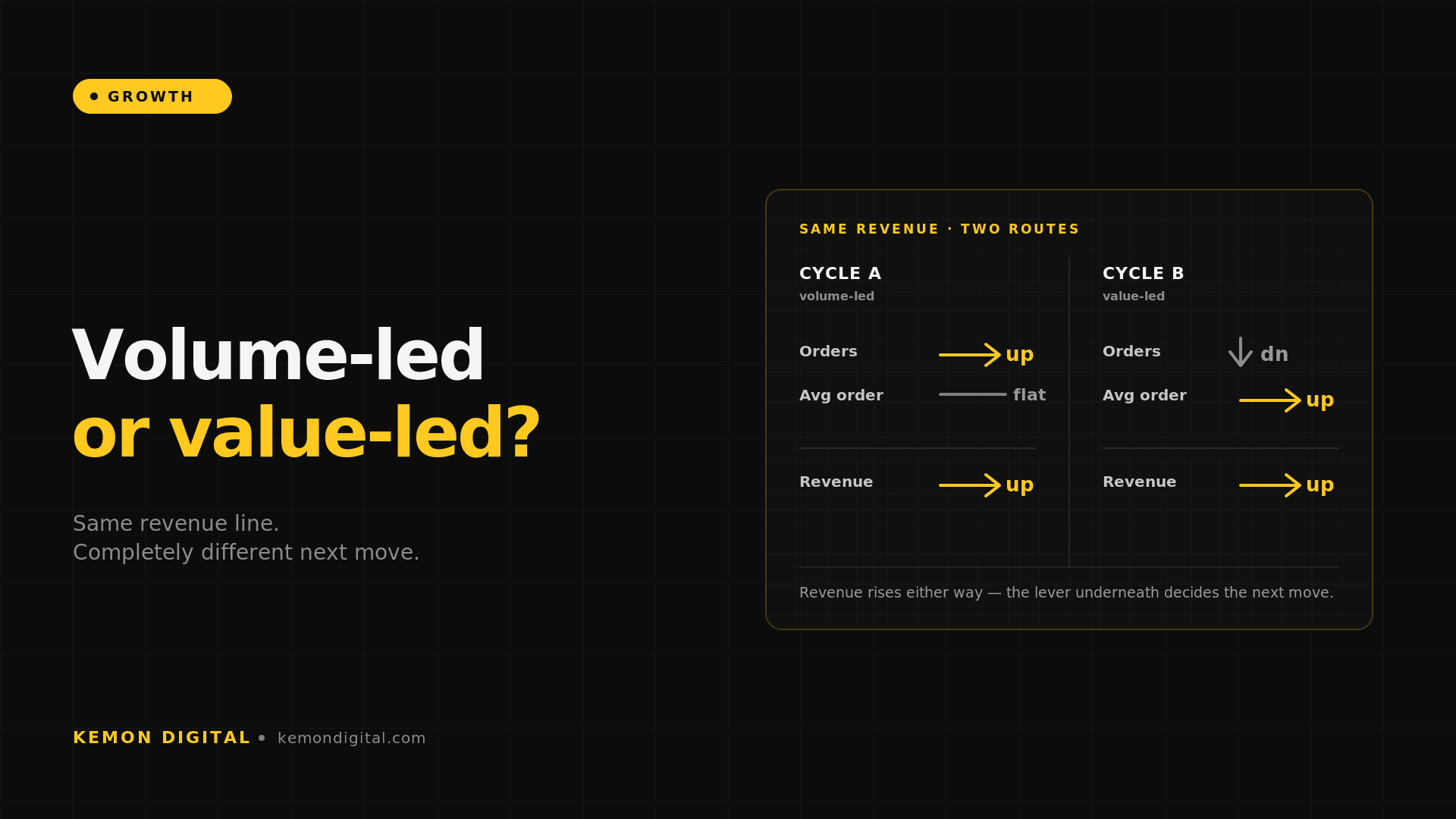
The first cycle was a volume turn. After several declining cycles, order count rose again — more buyers coming through the funnel. Average order value was roughly steady, so the gain was carried by quantity. That's an acquisition story, and it argues for one set of moves.
Then the very next cycle flipped the script. Order count actually fell. On the headline alone you'd brace for a down quarter. Instead, revenue grew — because average order value jumped by double digits. Fewer orders, each one materially larger. That's a value turn: the business sold more to the customers it already had, deepening baskets rather than widening the funnel.
Same direction on revenue, opposite engine underneath. One was "we acquired more." The other was "we monetized deeper." If you can't tell them apart, you can't deploy against either.
The fix: decompose before you deploy
We made the volume-versus-value split a standing line in every cycle report, ahead of the revenue headline rather than buried beneath it.
- Attribute the growth before reacting to it. For each cycle we state plainly which factor moved — order count, average order value, or both — and by how much in percentage terms. The revenue number stops being the conclusion and becomes the output of two diagnoses.
- Match the next dollar to the engine. Volume-led cycles point the headroom at acquisition and conversion — reach, funnel, the checkout itself. Value-led cycles point it at retention, basket-building, merchandising, and AOV plays — bundles, cross-sell, the higher tier of the range.
- Watch the two together. A value-led cycle with falling orders is healthy if it's intentional and dangerous if it's quiet attrition wearing a good revenue number as a disguise. A rising AOV on a shrinking buyer base is a flag to check, not a victory to bank.
None of this required new tooling. It required refusing to let a single number stand in for two decisions.
FAQ
Q: What's the difference between volume-led and value-led growth? A: Volume-led growth comes from more orders — more buyers moving through the funnel — with average order value roughly steady. Value-led growth comes from bigger baskets — a higher average order value — even if order count holds or falls. Both move the same revenue line, but they're different businesses underneath and demand opposite responses.
Q: How do I decompose revenue into volume and value? A: Revenue equals order count times average order value. Each cycle, state both factors separately and note which one moved and by how much in percentage terms. The headline revenue figure is the product of the two, not the insight — the insight is which lever did the work.
Q: Why does it matter which engine is driving growth? A: Because the right response to each is opposite. Volume-led growth argues for acquisition and conversion spend; value-led growth argues for retention, merchandising, and AOV plays. Acting on the headline alone, you'd over-invest in acquisition exactly when the opportunity had moved to depth — one of the most expensive mistakes a growing business makes.
Don't trust the headline to make the decision
A revenue number that went up is not a strategy. It's a question. The hardest discipline in reading a business is refusing to act on the top line until you've taken it apart.
Want to know which engine is carrying your growth? Kemon runs an AI-driven growth-quality audit that decomposes your revenue into volume and value and points the next dollar at the real opportunity. Talk to us →