Four Brand Archetypes Every Multi-Brand Retailer Is Already Running (Whether They Name Them or Not)
Four brand archetypes every multi-brand retailer is already running (whether they name them or not)
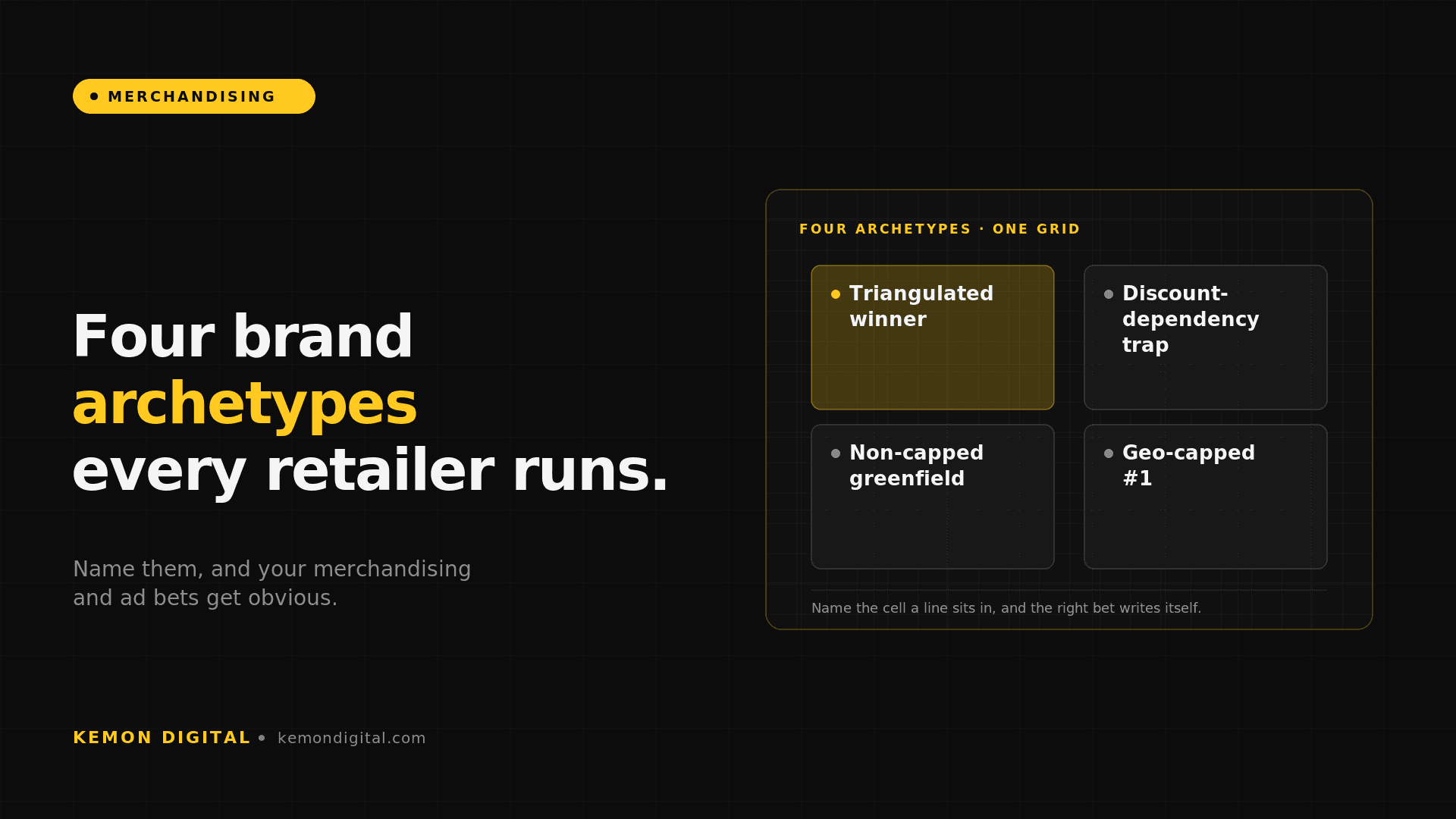
If you run a multi-brand retailer, you are already operating four different kinds of brand at the same time — most teams just never name them. So merchandising effort and ad budget get spread evenly across roles that demand wildly different bets. Across cycles on a luxury portfolio we run at seven-figure monthly GMV, the same four roles kept reappearing: the triangulated winner, the discount-dependency trap, the non-capped greenfield engine, and the geo-capped #1. Name the roles, and the allocation stops being a debate and starts being arithmetic.
The instinct in a portfolio is to rank brands by revenue and feed the top of the list. It feels rational. It's also how you end up funding a brand that has no room left to grow while starving the one quietly outperforming everything on a per-style basis.
Why revenue rank hides the real picture
Revenue rank is a single dimension. A portfolio is at least three: how much net margin a brand keeps after discounting, how much of its range is actually doing the work, and whether you're even allowed to sell it everywhere. Read those together and the brands sort themselves into four recurring roles. We didn't invent the roles — we kept seeing them, cycle after cycle, until naming them became unavoidable.
Two diagnostics do most of the work. The first is handle activation: of all the styles a brand offers, what percentage actually generate sales? A low activation rate on a strong net performer isn't a weakness — it's headroom, range that hasn't been switched on yet. The second is the gross-to-net gap: how far a brand's rank falls once you strip the discount haircut out and look at margin instead of sticker revenue. Run every brand through both, layer in distribution rights, and four archetypes appear.
The four archetypes
1. The triangulated winner. The top net performer — strong on margin, not just gross revenue — with very low handle activation. Only a small share of its styles are carrying the brand, which means most of the range is untapped headroom rather than dead weight. The catch: this winner is often geo-capped, its distribution limited by the rights you hold. Enormous latent upside, real ceiling on where you can capture it.
2. The discount-dependency trap. The brand that's gross #1 by revenue but collapses to net #2 the moment you remove the markdown, with its share of net revenue eroding cycle over cycle. It looks like the hero of the portfolio and behaves like a volume engine running on discount. Healthy only as a deliberate bridge — never as a brand you mistake for a winner.
3. The non-capped greenfield engine. The highest productivity per style in the portfolio, unrestricted distribution, riding a brand-expansion window where demand is opening faster than supply. No geographic ceiling, best unit economics, momentum at its back. This is the one to scale — and the one most likely to be under-resourced because it doesn't yet top the revenue table.
4. The geo-capped #1. A genuine leader, strong on every honest metric — that you simply cannot sell everywhere because the rights are territory-bound. The right move isn't "grow it past its ceiling," it's "max it out inside the territory you're allowed and stop modeling phantom expansion."
The same four roles, cycle after cycle. Different brands rotate through them, but the archetypes hold.
How to allocate to the role, not the rank
We stopped ranking the portfolio by gross revenue and started classifying it by role:
- Tag every brand with an archetype each cycle. Net rank, handle activation, gross-to-net gap, and distribution status go into a single view, and each brand lands in one of the four buckets. The label, not the revenue line, drives the conversation.
- Allocate to the role. The greenfield engine gets the scaling budget. The triangulated winner gets activation work to switch on its dormant styles inside its allowed geography. The geo-capped #1 gets maximized, not over-modeled. The discount-dependency trap gets managed as a bridge, watched on net, and paced for wind-down.
- Re-classify, don't assume. A brand can move between archetypes as activation rises or a discount habit deepens. The tagging is a standing line in the cycle report, not a one-time exercise.
The payoff isn't a single number — it's that allocation decisions that used to be argued became obvious. The scaling budget moved to the greenfield engine, activation effort moved to the triangulated winner's dormant range, and the gross #1 stopped being treated as untouchable simply because it sat at the top of the revenue table.
FAQ
Q: How do I tell a triangulated winner from the discount-dependency trap? A: Read them on net margin and handle activation, not gross revenue. The triangulated winner ranks at the top on net with most of its range still dormant — low activation is headroom waiting to be switched on. The discount-dependency trap ranks #1 on gross but falls on net the moment you remove markdown, and its net share erodes cycle over cycle. One has upside it hasn't tapped; the other has a lead it's handing back at the till.
Q: Which archetype should get the scaling budget? A: The non-capped greenfield engine, almost always. It has the best unit economics, no geographic ceiling, and momentum — yet it's the one most likely to be under-resourced because it doesn't yet top the revenue chart. Scaling the gross #1 instead is how budget goes to a brand with no headroom.
Q: Can a brand change archetypes over time? A: Yes — that's why classification is a standing line in every cycle report, not a one-time exercise. A winner can drift into discount dependency, and a greenfield engine can hit a ceiling once rights tighten. Re-tag each cycle rather than assuming last cycle's role still holds.
Stop spreading budget evenly across four different jobs
The reason multi-brand budgets get spread evenly is that, without names, every brand looks like the same kind of asset. They aren't. Four roles, four ceilings, four right moves — and the moment you name them, the next merchandising and ad bet stops being a debate.
Want your portfolio classified by role instead of rank? Kemon runs an AI-driven portfolio audit that scores every brand on net margin, handle activation, and distribution rights, then maps each to its archetype and the right move. Talk to us →