Curated vs Blast — The Luxury Email That Earns Many Times More Per Send
Curated vs blast: the luxury email that earns many times more per send
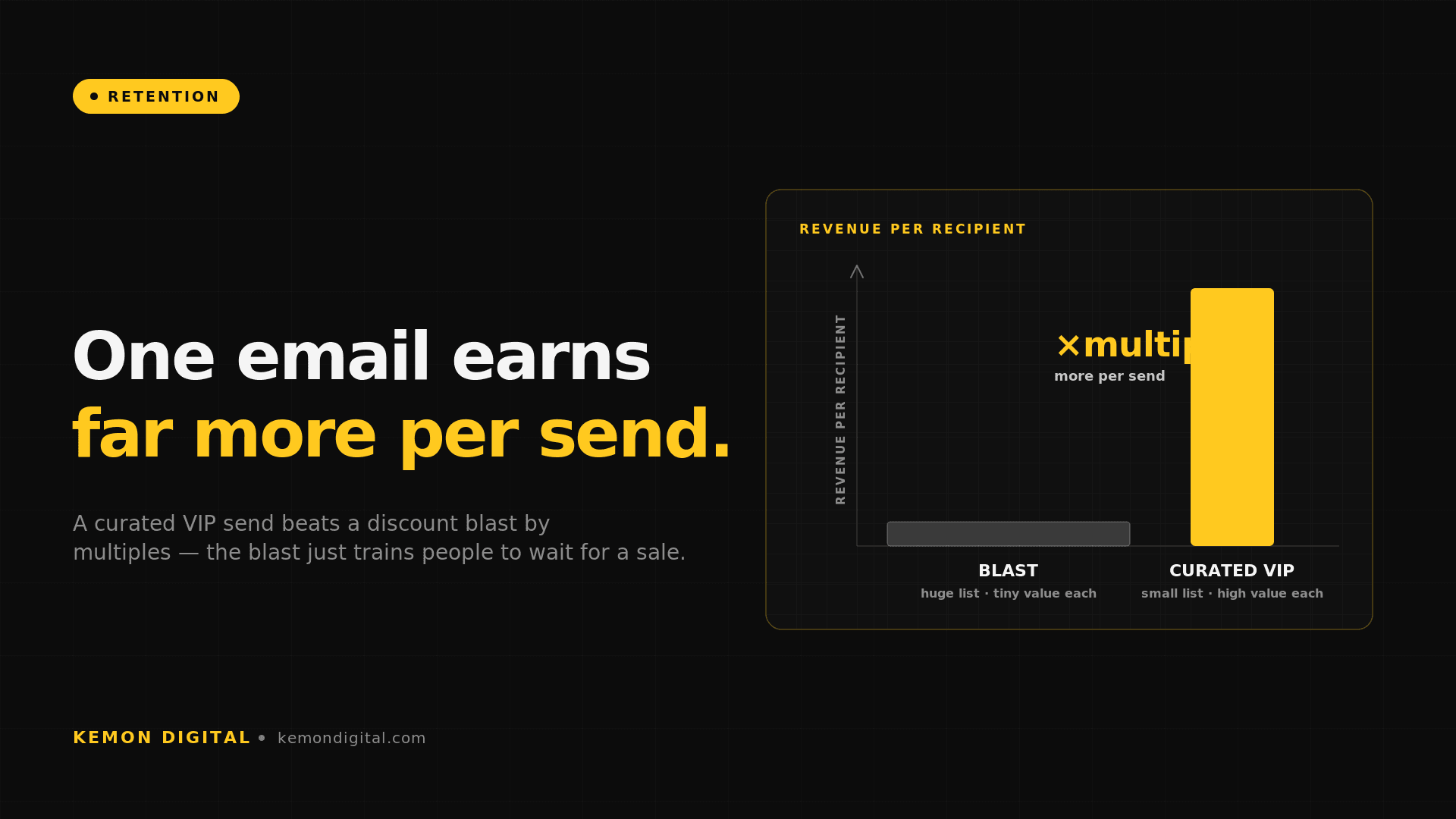
If you run luxury email marketing, the most valuable lever in the channel probably isn't deliverability — it's the choice of what you send and who you send it to. On a storefront doing seven-figure monthly GMV, we put two sends from the same week side by side on a per-recipient basis. A curated, VIP-segmented send earned many multiples more revenue per recipient than a broad, discount-led blast.
The inbox was never the bottleneck. Content and coverage were.
Why a healthy-looking email program still leaks value
By every surface metric you'd check on a Monday dashboard — deliverability, open rate, flow count — the program looked like a success story. That's exactly why the real lever is invisible. Headline opens and clicks tell you the email landed. They don't tell you what it earned per head, and they don't tell you what the blast is quietly costing in future full-price demand.
Two sends with identical deliverability can be an order of magnitude apart in revenue per recipient. The blast looks productive — big audience, decent open rate, real revenue in absolute terms. On a per-head basis it earns pennies, and it does something worse than under-earning: it trains your best customers to wait for the next markdown. For a premium brand, that's not low ROI on one send. It's erosion of full-price demand across every future one.
What the per-recipient view actually showed
We measured at the level that matters: revenue per recipient — money earned per person the email reached, not opens, not clicks. Two findings sat underneath the headline curated-vs-blast gap.
First, a flow-classification opportunity. In the flow library, a sequence was queued to go live that, on inspection, duplicated a flow already running. Activating a duplicate is the most expensive move available in email: you double-message customers, cannibalize the original flow's attribution, and tax the list's trust all at once. The skill isn't building flows — it's reading each one and deciding whether it fills a genuine coverage gap or is a legacy draft of something already earning quietly in the background.
Second, the welcome sequence had room to grow. The second touch in the new-subscriber series was reaching only a fraction of the people who entered it. New subscribers are the highest-intent audience email ever sees — they just raised their hand. A second touch that reaches most of them, rather than a fraction, roughly restores the new-customer value the program could capture. And because paid acquisition economics depend on what a new subscriber is worth once they land, closing that gap also lifts the ceiling on how hard you can push paid traffic.
The fix: treat email as infrastructure, not a calendar
We treated email the way we treat checkout — as infrastructure with measurable economics:
- Reusable VIP segments. Rather than rebuilding an audience by hand for each send, we defined durable, reusable segments — high-value, recently-active buyers — so the curated, high-revenue-per-recipient send becomes the default motion, not a one-off someone has to remember to assemble.
- Classify every flow. We tagged each flow as "earns by design" or "fills a genuine gap." Anything that duplicated a live flow was stood down before it shipped. Only sequences covering a real, uncovered moment in the lifecycle were cleared to activate.
- Complete the welcome second-touch. We adjusted entry and send conditions so the second touch reaches the full cohort of new subscribers, restoring the new-customer value that was on the table — and with it, the headroom to scale paid acquisition against a higher subscriber worth.
- Shift the mix toward curation. We rebalanced the calendar away from broad discount blasts and toward curated, segmented sends, protecting full-price demand instead of eroding it.
FAQ
Q: What does "revenue per recipient" mean and why use it over open rate? A: It's the revenue a send earns divided by the number of people it reached — money per head, not engagement. Open and click rates tell you an email landed and got attention; they don't tell you what it earned or what it cost you in future demand. Put a curated send and a blast side by side on a per-recipient basis and the real economics appear: the blast often earns pennies per head while training buyers to wait for a discount.
Q: Why is activating a duplicate flow such an expensive mistake? A: Because it compounds. A duplicate of a live flow double-messages customers, splits and cannibalizes the original flow's attribution, and erodes list trust — all at once. The fix isn't building more flows. It's auditing the library first and classifying each queued flow as a genuine coverage gap or a legacy draft of something already earning.
Q: How does a welcome flow affect paid acquisition? A: Paid acquisition economics depend on what a new subscriber is worth once they land. If your welcome second-touch reaches only a fraction of new subscribers, you're capturing only part of that value — which caps how hard you can afford to push paid traffic. Completing the flow lifts subscriber worth and, with it, the ceiling on paid spend.
Curate, don't blast
The uncomfortable truth for most premium brands is that a healthy-looking email program can still be leaving most of its value on the table — not because the inbox is hard, but because the easy, high-volume send is the one that earns the least per head.
Want to know what your email is really earning per recipient? Kemon runs an AI-driven retention and email audit that measures per-send economics, classifies your flow library, and prioritizes fixes by revenue impact. Talk to us →