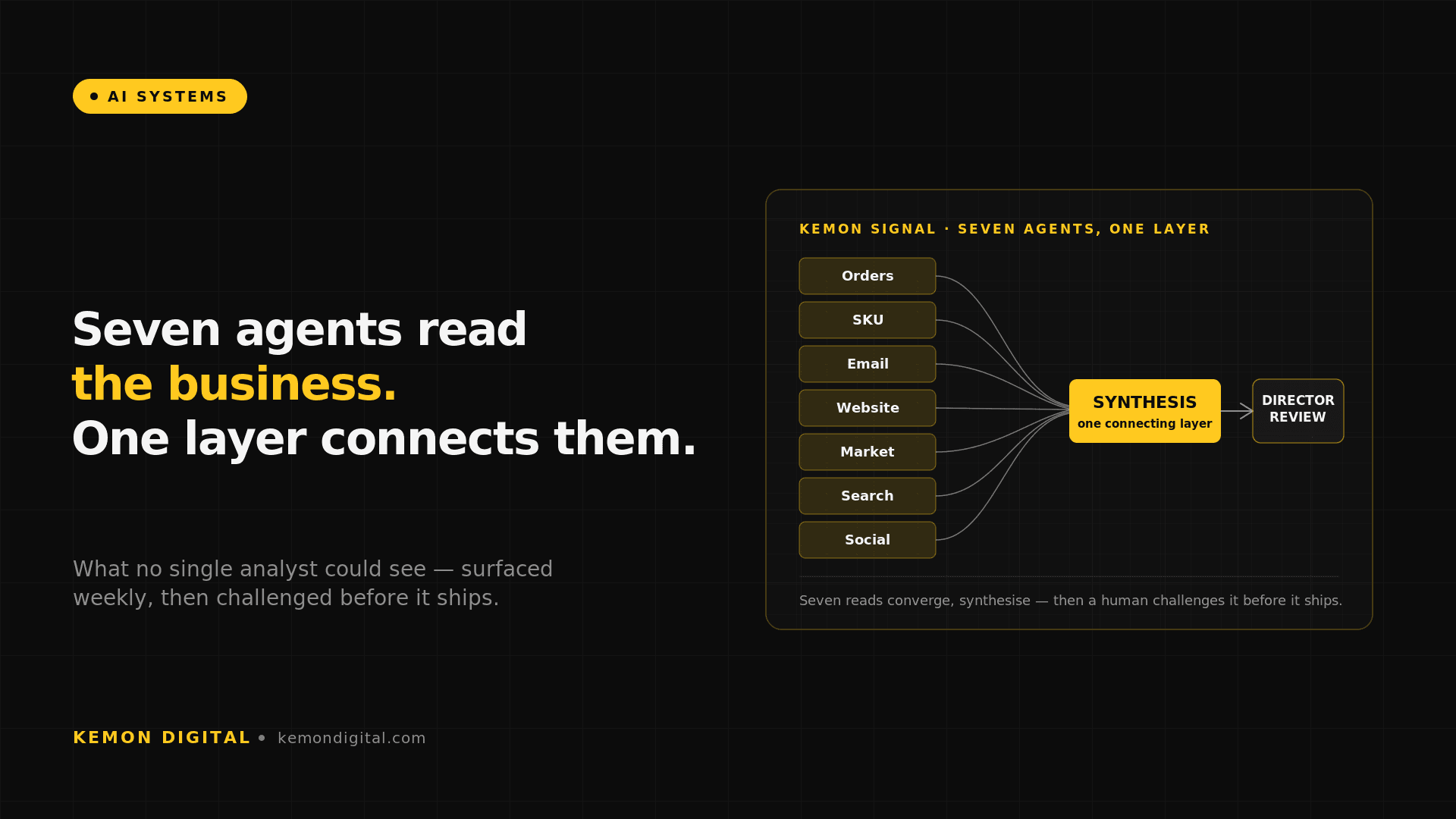
How Signal Works — Many AI Agents Read the Business, One Layer Connects Them
How Signal works: many AI agents read the business, one layer connects them
Run seven AI agents across a business in parallel and you get seven channel reports. The value isn't in any one of them. It's in the layer that connects what no single analyst — human or agent — could ever hold at once. That layer is what Signal actually is.
Why more data isn't the problem
Most analytics setups have the opposite problem to the one people assume. The issue is rarely too little data. It's that the data lives in silos that never talk to each other — the paid-search report, the email dashboard, the storefront analytics, the marketplace feed — each owned by a different tool, each telling a story that's locally true and globally misleading.
A human team handles this by holding a weekly meeting and hoping someone connects two dots from two different dashboards before it ends. That works occasionally. It doesn't scale, it depends on who's paying attention that week, and it's slow. Signal makes that connection the default, not the lucky exception.
What a single-channel view misses
Run a business through specialist agents and the first lesson is that a single-channel view is almost always locally true and globally wrong.
Take a pattern we see constantly. The paid-social agent reports a strong week — traffic up, cost per click down, a campaign clearly winning. Read in isolation, the recommendation writes itself: pour more budget in. But the website agent and the orders agent are looking at the same flow from the other end, and they can see the traffic lands on a checkout that leaks most of it before payment. The "win" is spending more to fill a bucket with a hole in it. No agent is wrong. The paid-social agent is right about the auction — it just can't see the floor.
A second pattern: an email tool over-crediting itself. Most channel tools attribute generously — every conversion that so much as brushed an email gets claimed. Read the email dashboard alone and the channel looks like the hero, which distorts every downstream budget call in its favor. Only when you reconcile the email agent's claims against the orders agent's ground truth does the real contribution emerge — usually a fraction of what the tool reported.
These aren't edge cases. They're the normal condition of a multi-channel business: every dashboard is honest and every dashboard is partial. The thing worth building isn't a smarter dashboard. It's the layer above all of them.
The three parts of Signal
Signal has three parts, and the order matters.
- Seven specialist agents, one per slice. Each agent owns a domain — orders, products and SKUs, email, website, market, paid search, paid social — and reads it deeply rather than broadly. A specialist with one channel to understand reads it far better than a generalist spread across all seven.
- A synthesis layer that connects across them. This is the actual product. It takes all seven reads and looks for the cross-channel truths no individual agent can hold: the paid win wasted on a leaking checkout, the email tool crediting itself, the product feed starving a campaign the paid agent thinks is healthy. It reconciles claims against ground truth and produces one connected picture instead of seven disconnected ones.
- A director-review pass. Before anything ships, a final pass plays the adversary. It challenges every recommendation — is the inference sound, is the impact overstated, would a skeptical operator buy it? — and corrects claims downward where they don't hold. It also converts vague pitches ("invest more in social") into specific, owner-assigned actions ("pause this ad set; route the budget here; fix this checkout step first"). What ships isn't a list of insights. It's a list of decisions, each with a name attached.
The result: a weekly read-and-act cycle
The output is a weekly read-and-act cycle a human team can't produce at the same depth or speed. Seven channels read in parallel, every cross-channel contradiction surfaced, every recommendation adversarially pressure-tested and corrected down, every action assigned to an owner — every week, on live infrastructure. A human analyst can do any one of those things. What they can't do is hold all seven channels in their head at once, catch the contradictions between them, argue against their own conclusions, and turn the survivors into assigned actions — every single week without the quality drifting.
The bottleneck in most operations was never analysis. It was synthesis: the connective work of making siloed channels talk to each other fast enough to act on. Signal makes that the default motion.
FAQ
Q: What makes a synthesis layer different from a dashboard that combines channels? A: A combined dashboard stacks channels next to each other; it still leaves you to spot the contradictions. The synthesis layer actively reconciles each channel's claims against ground truth — catching, for example, that a "winning" paid campaign lands on a leaking checkout, or that an email tool is over-crediting itself. It produces one connected read of the business, not seven panels you have to connect yourself.
Q: Why run seven specialist agents instead of one general one? A: Depth. A specialist that only has to understand one channel reads it far better than a generalist spread across all seven. That depth per slice is what makes the synthesis layer worth having — you can only connect channels well if each one was read well first.
Q: What does the adversarial review pass actually change? A: A recommendation no one argued against is usually overstated, and an insight with no name attached never ships. The review challenges every claim, corrects it downward where it doesn't hold, and converts vague pitches into specific, owner-assigned actions. What you receive is a list of decisions with owners, not a list of insights.
The answers are already in your dashboards
The uncomfortable truth for most operations is that the answers were already sitting in the dashboards — split across tools that never spoke to each other. Signal is the layer that makes them speak, argues with what they say, and hands you the decision instead of the data.
Want a weekly read-and-act cycle across every channel? Kemon builds and runs Signal on live commerce infrastructure. Talk to us →