How We Found Seven Figures of Hidden Revenue in Paid Media Budget Caps
How We Found Seven Figures of Hidden Revenue in Paid Media Budget Caps
Keywords: paid media budget cap optimization, google ads budget allocation, ai campaign analysis, cross-account paid media
Introduction
A luxury fashion retailer runs hundreds of paid-media campaigns across five regional ad accounts. The total spend is significant. The operation is complex. And the insight that unlocked seven figures of additional attributed revenue potential took an AI system to surface — not because the data was hidden, but because the pattern only emerges when you look at all campaigns simultaneously.
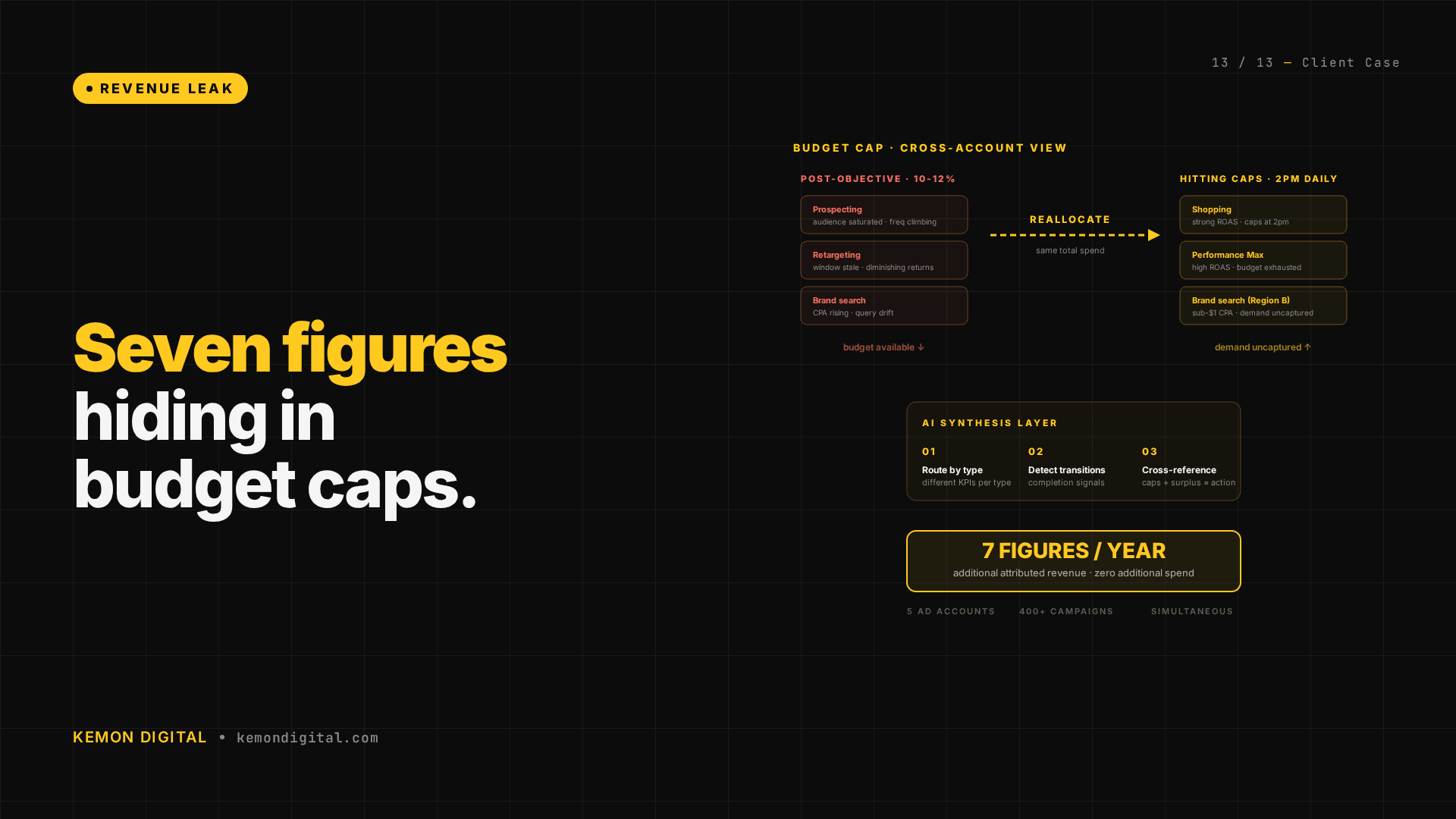
Here's what we found: roughly 10-12% of the combined paid-media budget was allocated to campaigns that had completed their role, while the highest-performing campaigns were hitting their daily budget caps by mid-afternoon. Budget waiting to be deployed was sitting in one place. Demand that couldn't be met was sitting in another. The two findings only become actionable when seen together.
This article explains how we found it, why human reporting misses it, and the principle that makes this kind of cross-account analysis possible.
The Scale Problem
Manually reviewing hundreds of campaigns across five ad accounts is not a task anyone can do well. Each account serves a different region. Each campaign has a different objective — brand search, prospecting, retargeting, shopping, Performance Max. Some have been running for months. Some launched last week.
The question "is this campaign still doing what it was designed to do?" requires context that changes over time. A prospecting campaign that was generating strong new-customer acquisition six months ago may have saturated its audience. A brand search campaign in one region may be capturing demand that's declining. A retargeting campaign may be re-engaging visitors who were never going to convert.
None of these are failures. They're natural transitions. The campaign achieved what it was designed to do, and the signal to move on is visible in the data. The problem is that detecting that signal across hundreds of campaigns — each with different KPIs, different maturity curves, and different regional dynamics — is beyond what a weekly reporting cadence can surface.
What the AI System Found
We run an 11-agent analytics system that analyses this retailer's full operation every cycle. The paid-media agent is one of seven channel agents. It evaluates all campaigns simultaneously using a framework designed to detect transitions — not just performance.
Two findings emerged from the same cycle:
Finding 1: Budget allocated to post-objective campaigns.
Approximately 10-12% of the combined budget was funding campaigns that showed consistent signals of completion: declining return on ad spend, audience saturation indicators, and CPA curves that had flattened or started climbing. These campaigns had done their job. The signal to transition that budget elsewhere was present in the data — it just needed to be read across accounts at the same time.
Finding 2: Top performers hitting daily budget caps.
The highest-performing campaigns — measured by attributed revenue per dollar spent — were hitting their daily budget limits between 2pm and 4pm. After that, they stopped serving. Every day, these campaigns had capacity to capture more demand, but the budget was exhausted.
These two findings are not unusual individually. What makes them valuable is seeing them together, at the same time, across all accounts. The move was straightforward: transition budget from campaigns that had completed their role to the ones still capturing demand at cap.
Why Human Reporting Misses This
This is not a competence problem. It's a structural one.
Reporting cadence is too slow. Most teams review campaign performance weekly or bi-weekly. Budget caps hit daily. By the time a weekly report flags a cap issue, the team has already lost days of potential revenue.
Reports are account-scoped. A media buyer managing one regional account sees that account's campaigns. They don't see that another region's retargeting budget is funding campaigns past their peak while their own top performer is capped at 2pm. Cross-account optimisation requires a cross-account view, and most reporting tools don't provide one.
Different campaign types need different evaluation criteria. Brand search should not be evaluated the same way as prospecting. Retargeting should not be evaluated the same way as shopping. A human analyst applying a single performance rubric across hundreds of campaigns will miss the transitions that matter — because the signal looks different for each type.
Transition detection is harder than performance reporting. Reporting tells you what happened. Transition detection tells you when something has changed enough to warrant action. The difference is the analytical framework: you need to define what "completed its role" means for each campaign type, then screen hundreds of campaigns against those definitions simultaneously.
The Routing Pattern
Anthropic's agent design research describes a pattern called "routing" — where different inputs are evaluated against different criteria before being synthesised into a unified view. This is the core of how the paid-media agent works.
The system does not apply one set of KPIs to all campaigns. It routes:
- Brand search campaigns are evaluated on impression share, CPA trend, and query match quality. A brand campaign with declining impression share but stable CPA is fine. One with rising CPA and broad-match query drift has completed its role.
- Prospecting campaigns are evaluated on new-customer acquisition rate, audience saturation signals, and frequency caps. A prospecting campaign that's re-engaging the same audience at increasing frequency has run its course.
- Retargeting campaigns are evaluated on return-visitor conversion rate, window freshness, and diminishing returns curves. Retargeting that's chasing visitors from over 30 days ago is typically past peak.
- Shopping and Performance Max campaigns are evaluated on ROAS trend, product-level contribution, and budget utilisation rate.
Each type gets its own evaluation framework. The synthesis layer is what brings them together — it sees that budget is available from completed prospecting campaigns and demand is uncaptured from capped shopping campaigns, and surfaces the transition.
The Revenue Math
The calculation was straightforward once both findings were visible.
Budget transitioning from post-objective campaigns to capped performers doesn't increase total spend. It reallocates existing spend from lower-performing to higher-performing campaigns. The delta is the additional revenue the capped campaigns could have captured if they'd had the budget.
For this retailer, at the scale of spend involved and the performance differential between capped and post-objective campaigns, the system identified seven figures of additional attributed revenue potential per year. No additional budget required. Same total spend. Different allocation.
This is not a forecast or a model. It's a reallocation: take budget that's generating declining returns and redirect it to campaigns that are hitting caps while still performing.
What Changed After the Analysis
The findings translated to three immediate actions:
1. Budget reallocation. Campaigns flagged as post-objective had their daily budgets reduced or paused. Freed budget was redistributed to capped campaigns with strong performance metrics. This was done within a single planning cycle.
2. Cap monitoring. The system now flags any campaign hitting its daily budget cap before 4pm. This is a continuous signal, not a one-time audit. If a campaign caps early, it's either performing well (increase budget) or bidding too aggressively (adjust strategy). Either way, the signal is actionable.
3. Transition definitions codified. The criteria for "campaign has completed its role" are now part of the analytical framework. Each campaign type has explicit signals the system watches for. The next cycle catches the next wave of transitions automatically.
The Principle
The value was not in analysing one campaign better. Every media buyer can optimise a single campaign. The value was in holding hundreds of campaigns in view simultaneously, applying different evaluation criteria to different types, and synthesising across them to find transitions that only appear when two signals are seen together.
Budget sitting in post-objective campaigns is invisible at the single-campaign level. Demand hitting caps is invisible at the single-account level. The two facts become a seven-figure opportunity only when they're seen together. That requires an analytical system designed for simultaneous cross-account evaluation — which is exactly what multi-agent AI architecture is built for.
FAQ
Q: Does this only work at the scale of hundreds of campaigns?
A: The pattern scales down. Even a business with twenty campaigns across two accounts can have budget stuck behind post-objective campaigns while performers cap out. The threshold for it to be worth automating depends on total spend — but the analytical principle is the same at any scale.
Q: How quickly can budget be reallocated?
A: Within a single day once the analysis is ready. The bottleneck is not execution — it's detection. Reallocating budget is a settings change. Finding which campaigns to reallocate from, and which to fund, is the analytical work. That's what the AI system does per cycle.
Q: Doesn't Google's automated bidding handle this?
A: Google's Smart Bidding optimises within a single campaign — bid adjustments, audience signals, placement decisions. It does not reallocate budget between campaigns, and it does not evaluate whether a campaign has completed its strategic role. Cross-campaign budget allocation is a human (or AI-assisted) decision. Google's automation and this analysis operate at different levels.
Q: What about Performance Max campaigns that manage their own budget distribution?
A: Performance Max redistributes budget across asset groups within a single campaign. It does not redistribute across campaigns or accounts. A Performance Max campaign hitting its daily cap at 2pm has the same problem — it needs more budget, and that budget might be sitting in a different campaign or account. Cross-campaign visibility is still required.
Q: How often should this analysis run?
A: Weekly is the minimum for most operations. The retailer we work with runs it on a regular cycle. The frequency should match the pace at which campaigns transition — in high-spend accounts with seasonal dynamics, weekly is appropriate. For smaller accounts with stable campaigns, bi-weekly or monthly may suffice.
Q: Can I do this without AI? What's the manual equivalent?
A: Yes, but it's time-intensive. Pull all campaign data into a single spreadsheet, define transition criteria per campaign type, screen every campaign against its criteria, and cross-reference budget caps with performance rankings. At the scale of twenty campaigns, that's a few hours of analyst time. At the scale of hundreds across five accounts, it's a multi-day project — which is why it gets done quarterly instead of weekly, and transitions go undetected for months.