ChatGPT is Now Sending More Traffic Than Paid Meta — for B2B Sourcing
ChatGPT is Now Sending More Traffic Than Paid Meta — for B2B Sourcing
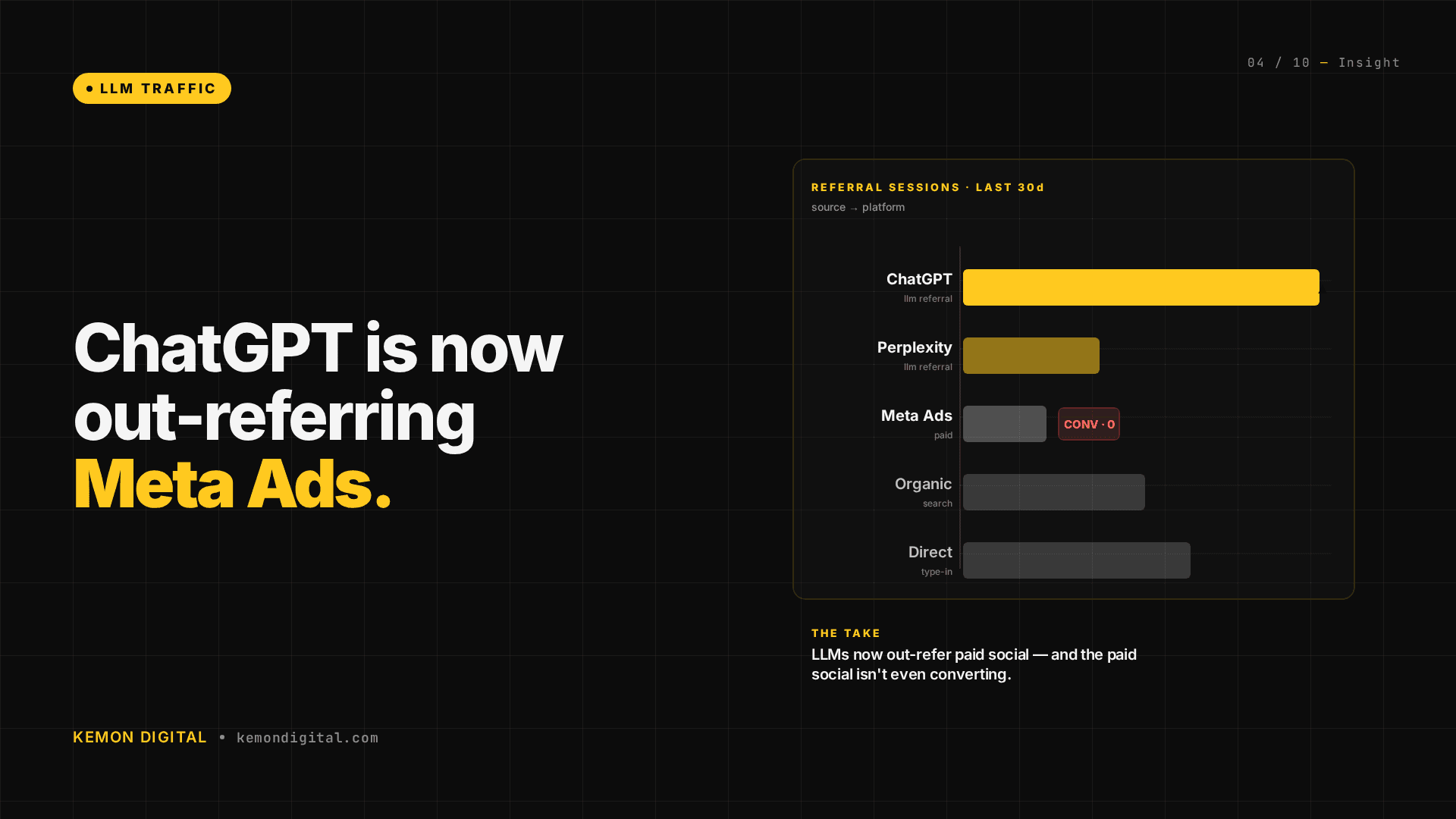
When a live B2B wholesale platform measures its 30-day traffic sources, the numbers reveal something that most marketing teams aren't watching yet: ChatGPT is sending more referral traffic than paid Meta ads — and Meta's campaign is converting at zero.
This isn't a campaign failure. It's a channel shift that nobody built into the playbook.
The platform's traffic picture
A Klang Valley B2B platform operating at meaningful monthly GMV measured its traffic channels across 30 days (mid-March to mid-April 2026):
Traffic sources by volume:
- Direct — dominant share (repeat buyers)
- Organic search (Google) — strong secondary share
- ChatGPT referrals — triple-digit sessions, exceeding paid Meta
- Paid Meta — double-digit to low triple-digit sessions
- Paid search — measurable, profitable
- Other search engines — minimal
Revenue by channel:
- Direct — approximately 70%
- Referral (organic + LLM) — approximately 20%
- Paid search — approximately 4%
- Organic (other) — approximately 3-4%
- Paid social — 0%
What paid Meta delivered (30d):
- Sessions: low triple digits
- Purchases: zero
- Revenue: zero
- Cost per purchase: undefined
In B2B Malaysia, this platform's paid Meta spend is returning no measurable sales.
Meanwhile, ChatGPT referrals are a real, quantifiable channel — and they're outperforming paid social.
Why is ChatGPT now a traffic source?
The platform published a batch of location-specific sourcing content in late March. Not generic "how to source" guides — specific articles like:
- "Where Can I Buy Halal Chicken and Beef in Klang Valley with Delivery?"
- "Fresh Seafood Suppliers in Kuala Lumpur — Current Prices, MOQs, Delivery Zones"
- "Frozen Meat Suppliers in Selangor with Cold-Chain Delivery"
These articles contain data that LLMs cannot hallucinate: real supplier names, current pricing, minimum order quantities, delivery zones, pack sizes.
When Malaysian businesses search ChatGPT for suppliers, the LLM retrieves and cites these articles because they contain specific, verifiable information. ChatGPT users click through, and the platform sees referral traffic in GA4.
This is Generative Engine Optimization (GEO) in practice.
The content that drives LLM citations has three characteristics:
- Real data — supplier names, not "find a supplier"
- Current specifics — pricing, MOQs, delivery zones updated regularly
- Location clarity — "Klang Valley," "Selangor," specific postcodes
Generic procurement advice doesn't trigger LLM citations. Specific sourcing data does.
Why isn't Meta converting?
Paid social has always been a reach channel — intended to catch buyers during the consideration phase. But the data suggests that in Malaysia's B2B procurement space, the consideration phase isn't happening on Facebook.
B2B buyers in Malaysia are making sourcing decisions in two places:
- Organic search (Google) — when they know what they want
- LLM search (ChatGPT) — when they want a specific recommendation
Neither of those moments happens in the Meta feed. Meta's strength is awareness. But B2B procurement doesn't need awareness — it needs execution. And execution is happening elsewhere.
Zero conversions from paid Meta isn't a poor campaign. It's evidence that the channel doesn't match the buyer behavior in this category.
The measurement blind spot
The /guide content site had been live for weeks before any analytics were connected. Dozens of articles published. Traffic already flowing. ChatGPT referrals already coming in.
Nobody could see it.
When GA4 and GTM were wired up on April 10th — within minutes, referral data started flowing. Suddenly, the traffic that had been invisible became visible.
This is the gap: If you don't measure a channel, you assume it doesn't exist.
But absence of measurement is not absence of value. ChatGPT had been sending traffic the whole time. The platform just wasn't watching.
Most B2B sites that publish content never check whether LLMs are citing them. They measure Google search, maybe paid channels, and call it done. But LLM citability is now a real, quantifiable revenue source — and it requires measurement to see.
How to build content that LLMs cite
The pattern is clear: specific sourcing data drives LLM citations.
If you're publishing B2B content and hoping to reach ChatGPT users:
Do this:
- Include supplier names, brands, actual businesses
- Publish current pricing (updated monthly)
- Specify MOQs, pack sizes, delivery constraints
- Name geography precisely (postcode, delivery zone)
- Include phone, email, website for suppliers
Don't do this:
- Generic "sourcing tips"
- Vague pricing ranges ("call for pricing")
- "Contact for quote"
- "Available nationwide"
LLMs cite data they can't generate themselves. Frameworks and advice, they produce in-house. Specific supplier information, they pull from sources. Feed LLMs specificity, and they cite you.
Implications for B2B marketing budget
1. LLM traffic is now a conversion channel.
Not an awareness channel. Not a vanity metric. A real conversion surface — measurable, reliable, growing.
If you're allocating budget only to Google and Meta, you're missing a channel that's already working.
2. Content strategy drives LLM channel performance.
No paid spend. No ad setup. Just specific content + measurement. The platforms that win are building GEO content strategy in parallel with traditional SEO.
3. Paid social ROI varies by market and category.
For this Malaysian B2B platform, paid Meta returned zero revenue. That's a data point. Before you assume paid social is essential, measure where your buyers actually convert. It might not be Facebook.
4. Measurement unlocks channels you didn't know existed.
Until GA4 was connected, ChatGPT referrals were invisible. Now they're a measurable revenue source.
If your content is live but not measured, traffic is flowing to you that you can't see.
FAQ
Q: Is ChatGPT traffic real, or is it temporary? A: ChatGPT's user base is growing month-over-month, and LLM adoption in business research is accelerating. This platform has been measuring ChatGPT referrals consistently over 30 days. It's real, and it's growing.
Q: Will ChatGPT traffic replace Google search for B2B? A: No. Google search is still dominant. But ChatGPT is becoming a supplementary conversion channel for B2B platforms that publish specific, citable data. Both can coexist.
Q: How do I optimize for both Google AND ChatGPT? A: The same content that ranks in Google for specific queries also gets cited by ChatGPT. Real data beats generic advice in both places. Optimize for search intent, include specific information, and measure both channels.
Q: Why did Meta Ads return zero conversions? A: In B2B procurement, buyers aren't making sourcing decisions in the Meta feed. They're using Google and ChatGPT. Channel-buyer mismatch, not campaign failure.
Q: How long before LLM traffic becomes meaningful for B2B? A: If you're publishing specific content, it's already meaningful. This platform saw triple-digit ChatGPT referrals within 4 weeks of publishing location-specific sourcing data.
Q: Do I need special tracking for ChatGPT referrals? A: Standard GA4 handles ChatGPT referrals automatically. Referrals from ChatGPT.com appear in your referral traffic. Just ensure GA4 is measuring the right property.
Optimize your B2B content for LLMs. If your platform publishes content but you're not measuring ChatGPT referrals, or your paid social ROI doesn't match reality, we run channel audits and GEO content strategy. Contact Kemon Digital →