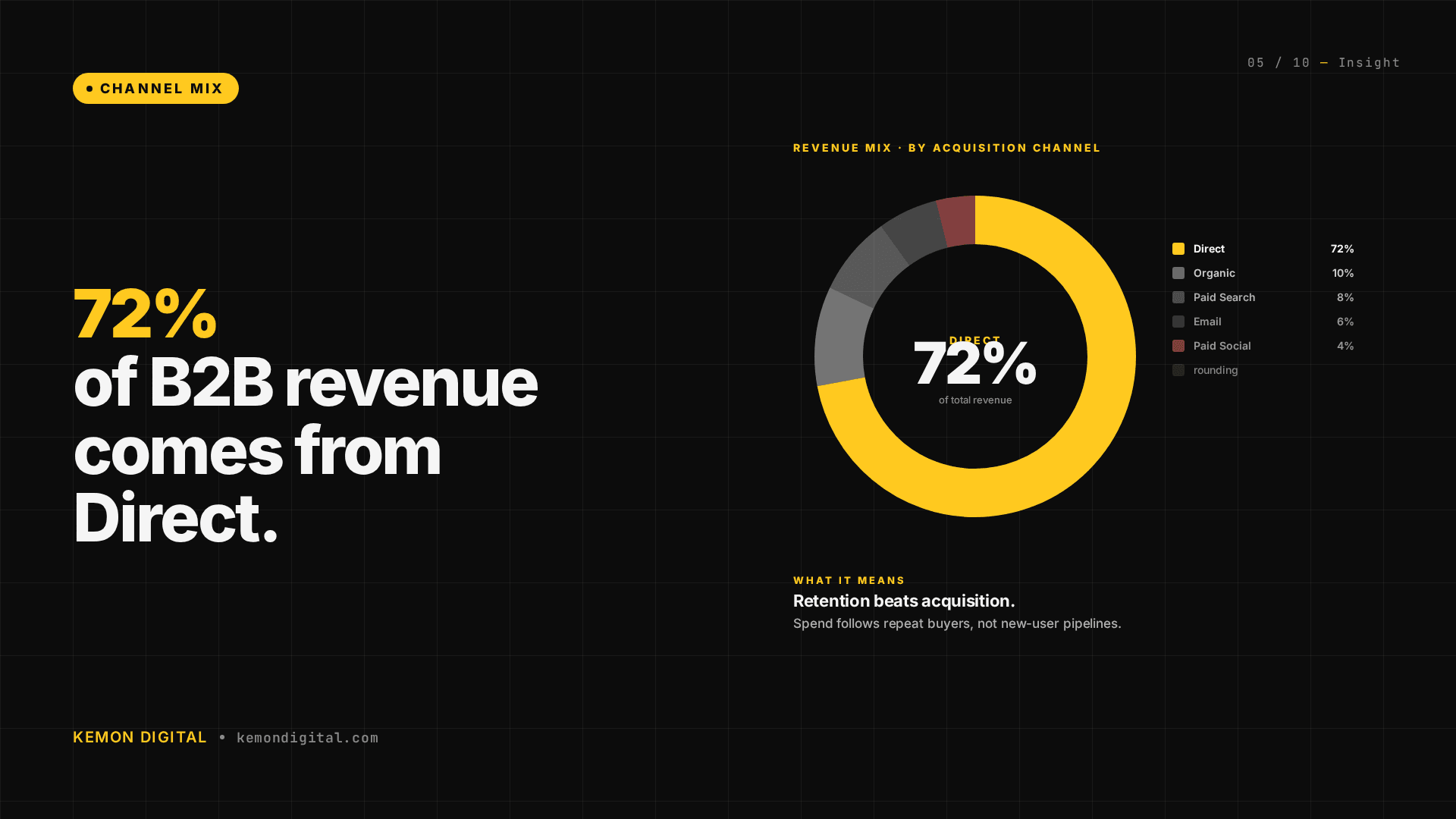
72% of B2B e-commerce revenue is Direct traffic — what your channel attribution is hiding
72% of B2B e-commerce revenue is Direct traffic — what your channel attribution is hiding
When most B2B e-commerce teams look at their GA4 dashboard, they see what every e-commerce team sees: Organic Search is driving the vast majority of traffic. Most focus goes toward optimizing Organic Search rankings, testing Paid Search keywords, and scaling what they can see and control.
What they usually miss: 72% of revenue is coming through Direct traffic — and that number inverts how you should be thinking about marketing spend.
The data from a B2B wholesale platform
We pulled 30 days of GA4 attribution from a B2B wholesale platform based in Malaysia. Here's what the channels actually delivered:
| Source | % of Sessions | % of Revenue | Conversion Rate |
|---|---|---|---|
| Organic Search | ~65% | ~3.5% | 0.5% |
| Direct | ~19% | ~72% | 37% |
| Referral | ~2% | ~20% | 10% |
| Paid Search | ~5.6% | ~4.4% | 0.8% |
| Paid Social | ~1.8% | ~0% | 0% |
Organic Search wasn't failing — it was driving the most traffic. But traffic isn't revenue.
Direct traffic wasn't the loudest — it was the most profitable by far.
Why Direct traffic is actually repeat buyers
The common mistake: treating Direct as "organic" traffic that doesn't need marketing.
The reality: Direct is repeat buyers with purchase intent already formed.
Here's the buying journey:
- Discovery via Organic Search. A prospect searches for your product category, finds your site, browses specifications.
- No purchase yet. They add items to cart, read reviews, compare alternatives. They leave.
- Return as Direct. Days or weeks later, they remember your domain, type it in directly, or use a bookmarked link.
- Purchase. This time, they convert. GA4 credits the purchase to Direct traffic.
The attribution is technically correct. The interpretation is usually wrong. Organic Search got them there the first time. Direct closed them on the second. Most platforms credit all revenue to the last touch — so Organic Search loses credit, and Direct gets credited for revenue that originated with organic discovery weeks earlier.
The hidden pattern: referral traffic
Referral traffic came in at only ~2% of sessions — but generated ~20% of revenue. That 10% conversion rate is 20x higher than Paid Search.
Why? Referral traffic typically comes from curated sources: B2B directories, industry review platforms, marketplace aggregators. These visitors are pre-qualified. They're not cold browsers. They're comparing a shortlist and came through because a trusted third party recommended you.
The smallest source by volume. The highest conversion rate. The second-largest revenue contributor.
That's signal about channel quality. Referral doesn't scale, but it tells you what efficient conversion looks like.
What this means for your paid spend
If your B2B e-commerce team is running Paid Search at 0.8% conversion and Paid Social at near-zero, and you're seeing modest ROAS or negative ROAS, the instinct is to spend more to improve at scale.
What the data suggests: paid channels aren't broken — they're filling a real but smaller segment. Cold prospecting is harder than closing repeat buyers.
Meanwhile, Direct traffic (repeat buyers) is converting at 37% — but gets dismissed as "non-marketing" because it carries no campaign tag.
The real constraint in B2B e-commerce isn't usually bid strategy. It's budget allocation matching reality:
- Paid channels are suitable for the small-but-real cold-prospecting segment (maybe 10-15% of volume).
- Retention (Direct, repeat, referral) is suitable for the larger segment (the majority of revenue).
If you're allocating 70% of spend to paid acquisition because that's where the visibility is, you might be overweighting the smaller segment.
Device and day-of-week patterns
~62% of traffic came from Desktop, ~38% from Mobile. But the day-of-week pattern is more telling: most orders cluster Monday through Wednesday, during business hours. Weekend orders are nearly invisible.
This is pure B2B behavior. Buyers are sitting at office desks, processing orders during the work week. They're not browsing on Friday evenings or Sunday mornings.
Average order value is typical of B2B wholesale — mid-three-figure MYR per transaction.
The conversion benchmark
B2B e-commerce industry benchmark is 5-10% conversion rate. This platform was well above benchmark, driven by repeat buyers. That's the signature of a business where retention is already working — it just doesn't look like it in last-click attribution models.
Four questions for your own business
- What does Direct traffic really represent in your GA4 report? Pull a cohort of Direct converters and check if they're repeat visitors. They almost always are.
- What's your repeat-buyer conversion rate vs. first-time-visitor rate? If repeat buyers are driving the majority of revenue, that's a signal your retention is working.
- Which channels are pre-qualifying your cold prospects? Referral and Organic Search are building awareness and intent. Use that quality signal to inform Paid Search keyword strategy.
- Does your paid budget match your acquisition burden or your revenue potential? If Direct is 72% of revenue, your paid budget doesn't need to be 72% of spend. It needs to deliver the cold-prospecting segment efficiently.
The takeaway
Most B2B e-commerce teams optimize for the wrong part of the funnel because the loud, visible, measurable part (acquisition campaigns) drowns out the quiet, invisible, harder-to-measure part (repeat buyers).
Last-click attribution is the culprit. It credits all revenue to the final touchpoint — which is usually Direct when the actual journey started with Organic Search or Referral weeks earlier.
If your channel attribution shows Direct as your biggest revenue driver but you're treating it as non-marketing, that's the signal to re-examine budget allocation.
Retention isn't less valuable than acquisition. It's just less visible in standard attribution models. Once you see it, the spend allocation question changes.
FAQ
Q: Why is Direct traffic conversion so high? A: Because Direct traffic is almost always repeat visitors. They've already bought once, they remember your domain, and they're coming back with intent. First-time visitors have much lower conversion rates (closer to 1-2%). The high aggregate conversion rate reflects the composition of the traffic, not the page quality.
Q: Should we stop investing in Paid Search if Direct is 72% of revenue? A: No. Paid Search is serving a real function — acquiring cold prospects. The question is whether the budget allocation matches the role. If Paid Search is delivering 4-5% of revenue but consuming 30% of budget, that's the optimization question. Paid Search might be more efficient at a smaller scale, paired with stronger Organic and Referral channels.
Q: How do we increase Direct traffic? A: You don't directly. Direct traffic is the output of visitors remembering your brand. It grows when: (1) repeat buyers have good experiences and come back, (2) Organic Search is building brand awareness, (3) customer retention metrics improve. Marketing spend on "Direct" isn't a thing — but investment in repeat-customer experience and organic visibility creates the conditions for more Direct traffic.
Q: Is this pattern specific to B2B or does B2C see it too? A: B2B sees it more acutely because buying cycles are longer and purchase values are higher. B2C e-commerce has shorter decision cycles and more impulse purchasing. But high-AOV B2C segments (luxury goods, subscriptions) show similar patterns.
Q: Can we use last-non-direct attribution instead? A: That's a step forward. Last-non-direct gives credit to the channel before Direct, which typically shows Organic Search or Referral. GA4 offers attribution modeling — you can run comparisons between last-click and data-driven models. For most B2B platforms, data-driven attribution will redistribute credit back toward Organic Search and Referral.
Published by Kemon Digital. We operate AI systems on live e-commerce infrastructure. If your channel attribution is hiding where revenue actually comes from, we run 90-minute diagnostic audits to surface the gaps. Contact us to see where your real conversion is happening.